Gutters and downspouts: the cheapest drainage fix
Clean gutters twice a year and send each downspout to ground that slopes away, 6 feet from basement walls. It costs far less than a French drain.
· Tulsa, Jenks, Bixby, Glenpool, Sapulpa, Sand Springs
The short answer
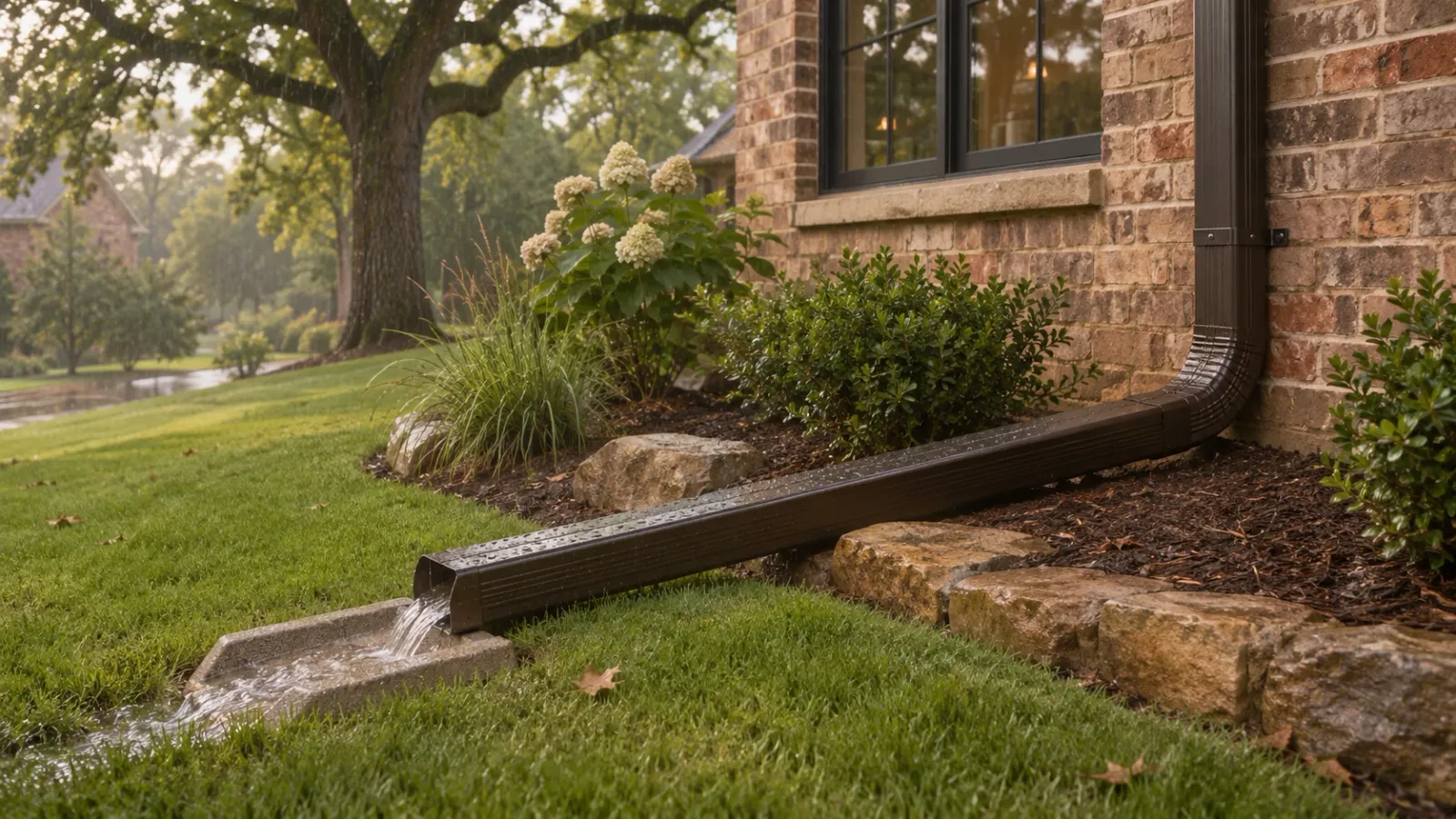
Before you pay for a drain or a regrade, fix the gutters and downspouts. Oklahoma State University Extension calls downspout disconnection a simple, inexpensive and low-maintenance way to control storm runoff, and its rules fit on a card: clean the gutters at least twice a year, drain no more than 1,000 square feet of roof into each downspout, and send the water to ground that slopes 1 to 5% away from the house, at least 2 feet from a crawl space and 6 feet from basement walls.
The price gap is wide. Thumbtack's Tulsa gutter cleaning page puts the national average for a cleaning at $100 to $130. LawnStarter's French drain cost guide, updated October 5, 2026, puts the average French drain at $5,000, with most jobs between $1,650 and $12,250.
How much water a roof sheds
A roof soaks up nothing, so every drop that hits it leaves through the gutters. The U.S. Geological Survey works out that one inch of rain puts 27,154 gallons on an acre. Scale that to 1,000 square feet of roof, OSU's limit for one downspout, and a one-inch storm sends about 620 gallons out of a single spout. OSU's downspout guide gives Tulsa about 35 inches of rain a year, which is roughly 21,700 gallons a year through that one downspout.
Dump that at the corner of the house and it soaks in next to the foundation or sits there. OSU's drainage fact sheet names too much roof water landing in one spot as one of the things that make a soggy yard worse.
Start with the gutters
OSU's maintenance list for gutters and downspouts:
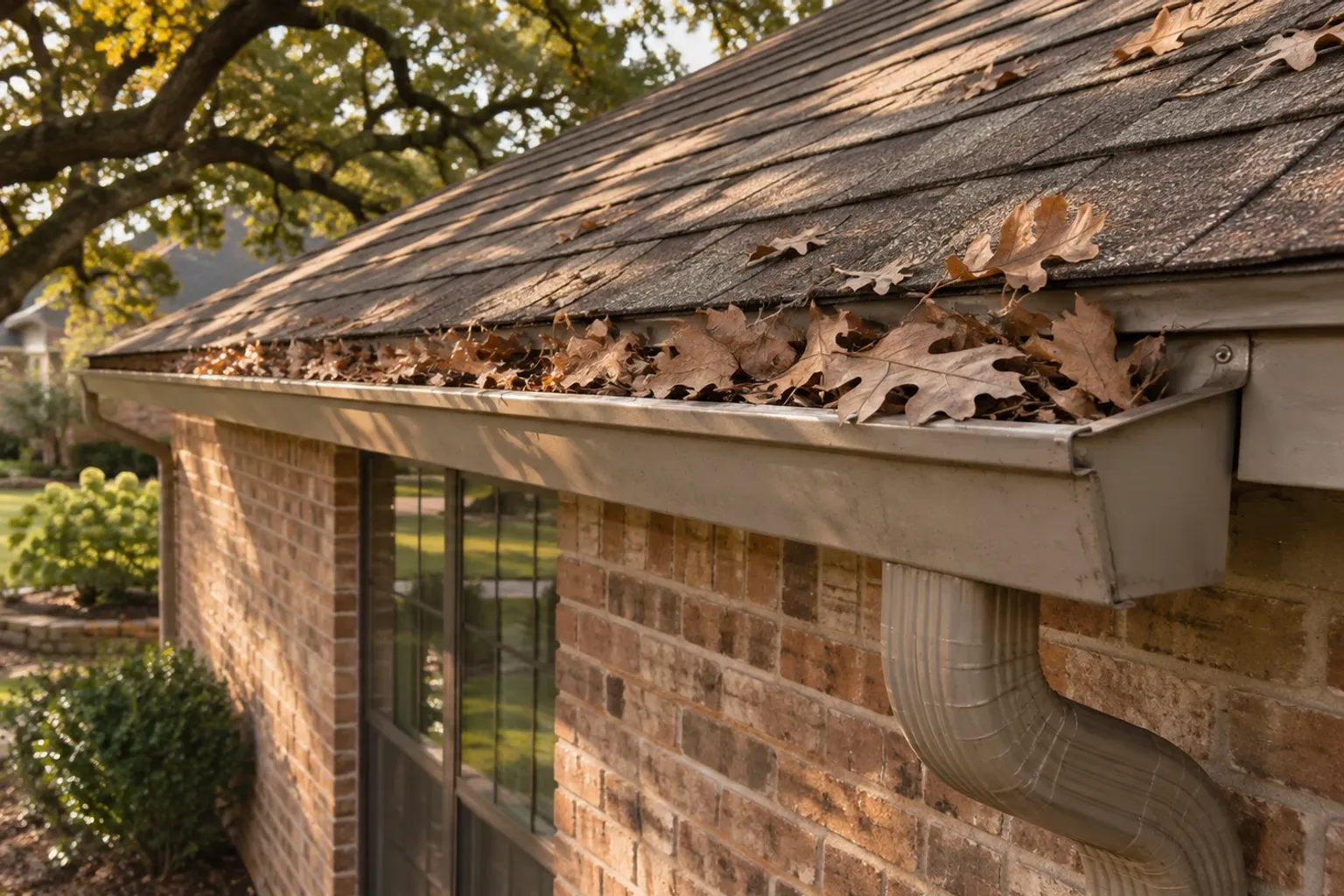
- Clean the gutters at least twice a year, more often if the house sits under trees.
- Keep every elbow and bend clear so it doesn't clog.
- Check the gutters and downspouts for holes and gaps.
- Add new hangers where a gutter starts to sag.
A clogged gutter overflows, and the water lands along the wall instead of at the downspout. If trees hang over the roof and you clean only once this fall, wait until they're bare so the gutters don't fill again a week later.
Then move the downspout
OSU's guide says every downspout should drain away from the foundation and away from the neighbors, onto a lawn, garden or shrub bed inside your own property line. It sets a few more limits:
- The receiving area should be at least 10% of the roof area it drains. A 1,000-square-foot section of roof needs about 100 square feet of lawn or bed.
- Leave at least 10 feet between the end of the downspout and the next paved surface downhill, so the water soaks in before it reaches a driveway or sidewalk.
- Don't drain over a septic tank, drain field or old buried tank.
- The yard should not hold standing water more than 48 hours after a rain.
OSU notes that Tulsa homes often send downspouts onto driveways, sidewalks or the street, where the water picks up car fluids, fertilizer and trash on its way to rivers and lakes. Pointing the spout at the lawn instead keeps more water on your property, where it can feed the grass.
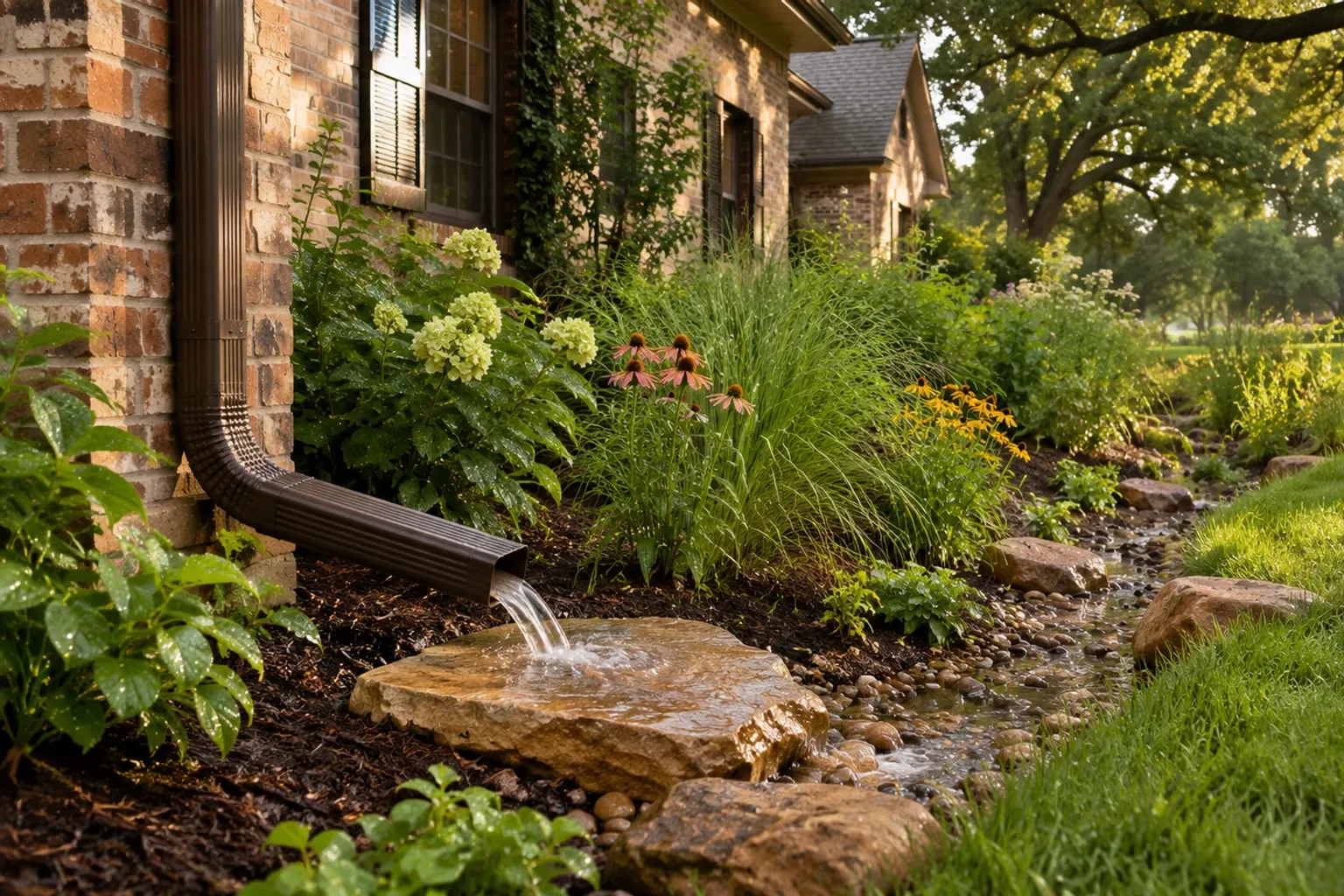
OSU's step-by-step for disconnecting a downspout: cut it at least 9 inches above the ground, cap the standpipe with a test plug if it ran underground, fit an elbow over the end, slide an extension pipe over the elbow pointed at the receiving area, fasten each joint with sheet metal screws in pre-drilled holes, and set a splash block where the water lands so it doesn't wash out the soil.
Clay soil changes the plan
OSU says many Oklahoma soils have little sand, and that changes what a downspout can do. Its downspout guide sorts soils into four hydrologic groups. Group D soils hold more than 40% clay, absorb little water and shed most of it as runoff. Simply turning a downspout onto the lawn works best on the sandier groups A and B. On group C and D soils, OSU recommends pairing the extension with a way to hold or spread the water: a rain garden, a swale, a rain barrel, or a gravel trench or dry well a previous owner may already have put in.
You can check your soil with OSU's ribbon test. Wet a small handful, roll it into a ball and knead it into a flat ribbon between your fingers. If the ribbon holds together, the clay content is high.
Rain gardens
OSU's rain garden fact sheet sizes the garden at 5 to 10% of the roof and paving that drain to it, and puts it at least 10 feet from any building. Dig the basin 6 to 8 inches deep and no deeper, because deeper water draws mosquitoes. Test the spot first: dig an 8-inch hole, fill it, let it drain, fill it again and time it. Divide 8 inches by the hours it took. Below 0.5 inch per hour, OSU says amend the soil or pick another spot. Call OKIE811 at 1-800-522-6543 before you dig.
Rain barrels
OSU says rain barrels can store part of the roof's water for watering later, with a catch: in a wet stretch the barrel fills before you need the water, so it needs a working overflow that sends the extra somewhere safe.
What the code says
OSU's guide says Oklahoma has no regulations for residential downspout disconnection. The model International Residential Code has a roof drainage section, R801.3, that calls for roof water on expansive soils to reach the ground at least 5 feet from the foundation or go to an approved drainage system. Oklahoma's adoption of the 2024 IRC, in effect since September 14, 2026, strikes that section from the state code.
The grading section stays. The ground must fall at least 6 inches in the first 10 feet away from the house, which our French drain vs. regrading guide covers.
Cities add their own rules. The City of Tulsa's residential guidelines say every new house must send its roof drainage to the street or another approved outlet, with exceptions decided case by case, and that any property must pass drainage along without damaging its neighbors. If you're building or adding on outside Tulsa, ask your city's permit office.
Common questions
How far should a downspout drain from the house?
At least 6 feet from basement walls and 2 feet from a crawl space, per OSU Extension, onto ground that slopes 1 to 5% away from the house. Keep it pointed away from the neighbors too.
How often should gutters be cleaned?
At least twice a year, OSU says, and more often if trees overhang the roof. Check the elbows and bends for clogs each time.
How many downspouts does a house need?
Enough that no downspout drains more than 1,000 square feet of roof, the limit in OSU's downspout guide. A 2,400-square-foot roof needs at least three.
Is it legal to drain my downspout onto my neighbor's yard?
Oklahoma has no state rule on residential downspouts, but OSU says every downspout should drain away from the neighbors' property and into a receiving area inside your own property line. Inside Tulsa, the city's residential guidelines say a property must pass drainage along without causing damage to the properties next to it.
Will extending my downspouts fix a wet yard?
Often it fixes the wet spot by the house. On heavy clay, OSU says the water may need somewhere to go once it leaves the extension, such as a rain garden or swale. If the yard stays wet more than 48 hours after rain, see why water pools in a yard.
When the downspout isn't enough
We handle downspout fixes, grading and French drains for yards in Jenks, Bixby, Glenpool, Sand Springs and Sapulpa. We look at where the roof water lands, where it collects and where it can safely go, and put the fix in a written quote. See how we handle drainage or send us photos of your downspouts during a rain.
Sources: Oklahoma State University Extension, BAE-1534: Minimizing Stormwater Runoff by Disconnecting Residential Downspouts (PDF, May 2017) · Oklahoma State University Extension, BAE-1542: Addressing Drainage Issues in the Urban Landscape (PDF, July 2020) · Oklahoma State University Extension, HLA-6454: Sustainable Landscapes: Designing a Rain Garden for Residential Property (PDF, October 2017) · U.S. Geological Survey, How much water falls during a storm? · Maricopa County, Building elevation plan requirements (restates IRC R401.3 grading) · Oklahoma Uniform Building Code Commission, 2024 IRC adoption rule (PDF, effective September 14, 2026) · Jaspector, IRC roof drainage code (restates IRC R801.3) · City of Tulsa, Residential Building Guidelines (PDF, January 2025) · Thumbtack, Gutter cleaning in Tulsa, OK · LawnStarter, How Much Does a French Drain Cost in 2026? (updated October 5, 2026)