
Build · Tulsa area
Drainage that works.
Water near the house, beds that wash out, a corner that never dries. We find where the water comes from and where it can safely go.
01The problem
Signs the yard needs drainage.
- Water collects near the house, beds wash out, or a low corner stays wet after rain.
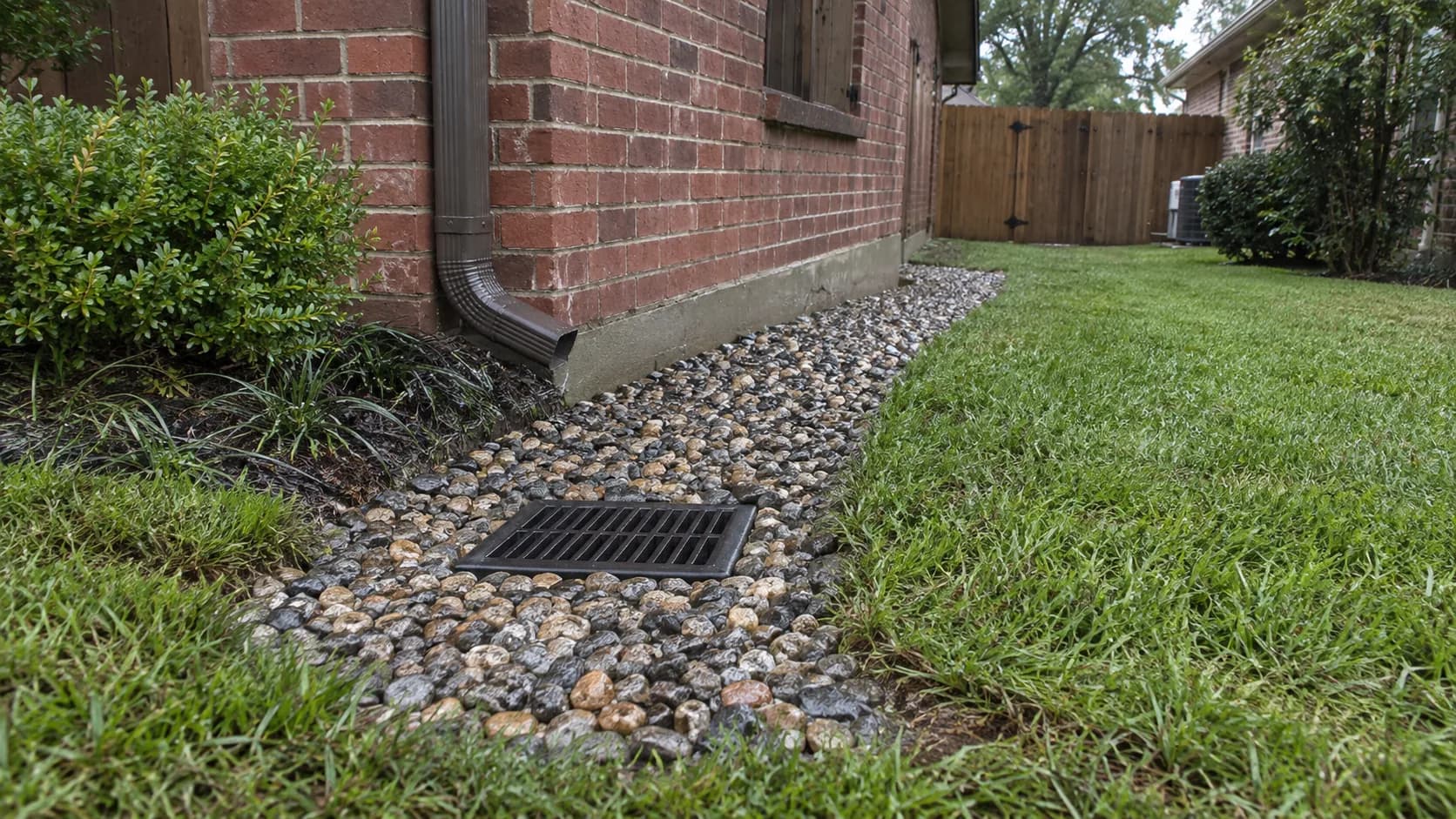
- Downspouts dump water against the foundation.
- Mulch and soil end up on the patio or sidewalk after a storm.
- Moss, standing water or soft ground in the same place every spring.
What goes under the surface
- 01Filter fabric
- 02Washed gravel
- 034" pipe
- 04Catch basins
02Specifics
How it's built.
Clay is slow
Most drainage problems around Tulsa start with the soil. OSU Extension notes that clay soils take in water slowly and crack in long dry spells. Its downspout guide explains that soils over 40% clay (hydrologic group D) absorb little water and shed most of it as runoff, so simply moving a downspout often isn't enough on clay.
Grade first
Oklahoma's residential code, now the 2024 IRC statewide, requires the ground to fall at least 6 inches in the first 10 feet away from the foundation, and hard surfaces within 10 feet to slope at least 2% away. Where a lot can't fit that, the code calls for swales or drains to carry the water off.
OSU warns against piling soil up the foundation to fix a low spot, because brick, insulation or studs behind raised soil stay wet. Regrading means moving the low point, not burying the house.
Downspouts
OSU's guide sets out where downspouts should drain: away from the foundation and the neighbors, at least 2 feet from a crawl space and 6 feet from basement walls, with no more than about 1,000 square feet of roof per downspout. The area receiving the water should slope 1 to 5% away from the house.
French drains and outlets
A true French drain is a trench of permeable rock that runs to the surface. A subsurface drain buries a perforated pipe in gravel below the surface. Both need an outlet: a pipe that daylights downhill, a dry well, or a sump pump where the yard is too flat for gravity. OSU also notes that soil works into every drain over time, so a good design leaves a way to clean it.
Tulsa's residential guidelines say a property can't block water flowing onto it from off-site, and must carry its own extra water to the street or another approved outlet where possible, without damaging the neighbors. The outlet is part of the design, not an afterthought.
03How it goes
From photos to finished.
- 01Send photosUse the quote form to send a few photos and tell us what the yard needs. We review the property and the work you want help with.
- 02We call youWe talk through the details and arrange a site visit if needed.
- 03On siteWe watch where the water comes from and where it collects, check the grade, and find where it can safely discharge.
- 04A written quoteThe work, inclusions, exclusions and price, in writing, before you decide to go ahead.
04Price
What sets the price.
Every quote is written for the property. These are the things that move it most.
- Length of drain or area to regrade.
- How far the water has to travel to a safe outlet.
- Whether the outlet can daylight or needs a dry well or pump.
- Catch basins, downspout connections and pipe size.
- Restoring beds, sod or paths after trenching.
- Access for equipment around the house.
05Questions
Common questions.
- Why does water pool in my yard after rain?
- Usually a mix of clay soil that drains slowly and grade that sends water toward a low spot. OSU notes that soils over 40% clay shed most rain as runoff instead of absorbing it.
- How much should my yard slope away from the house?
- Oklahoma's residential code requires at least 6 inches of fall in the first 10 feet, and hard surfaces near the house sloped at least 2% away.
- Where should a French drain empty?
- To an outlet lower than the drain: a pipe that daylights downhill, a dry well, or a sump pump. In Tulsa, the water can't be pushed onto a neighbor's property.
- How far should downspouts drain from the house?
- OSU Extension says at least 2 feet from a crawl space and 6 feet from basement walls, onto ground that slopes away from the house.
Got a wet corner?
Send photos during or just after rain if you can. They show us more than anything. We work in Bixby, Glenpool, Jenks, Sand Springs and Sapulpa.
Related guides
Drainage
Why does water pool in my yard after rain?Drainage
French drain vs. regrading: which fixes a wet yard?
Sources
- Oklahoma State University Extension, BAE-1542, home drainage fact sheet (PDF, July 2020)
- Oklahoma State University Extension, BAE-1534: Minimizing Stormwater Runoff by Disconnecting Residential Downspouts (PDF, May 2017)
- Oklahoma Uniform Building Code Commission, 2024 IRC adoption rule (PDF, effective September 14, 2026)
- Maricopa County, Building elevation plan requirements (restates IRC R401.3 grading)
- City of Tulsa, Residential Building Guidelines (PDF, January 2025)