
French drain vs. regrading: which fixes a wet yard?
Regrade when rain runs the wrong way and the yard has room to slope. Add a French drain when the ground stays soaked, seeps, or has no room for slope.
· Tulsa, Jenks, Bixby, Glenpool, Sapulpa, Sand Springs
The short answer
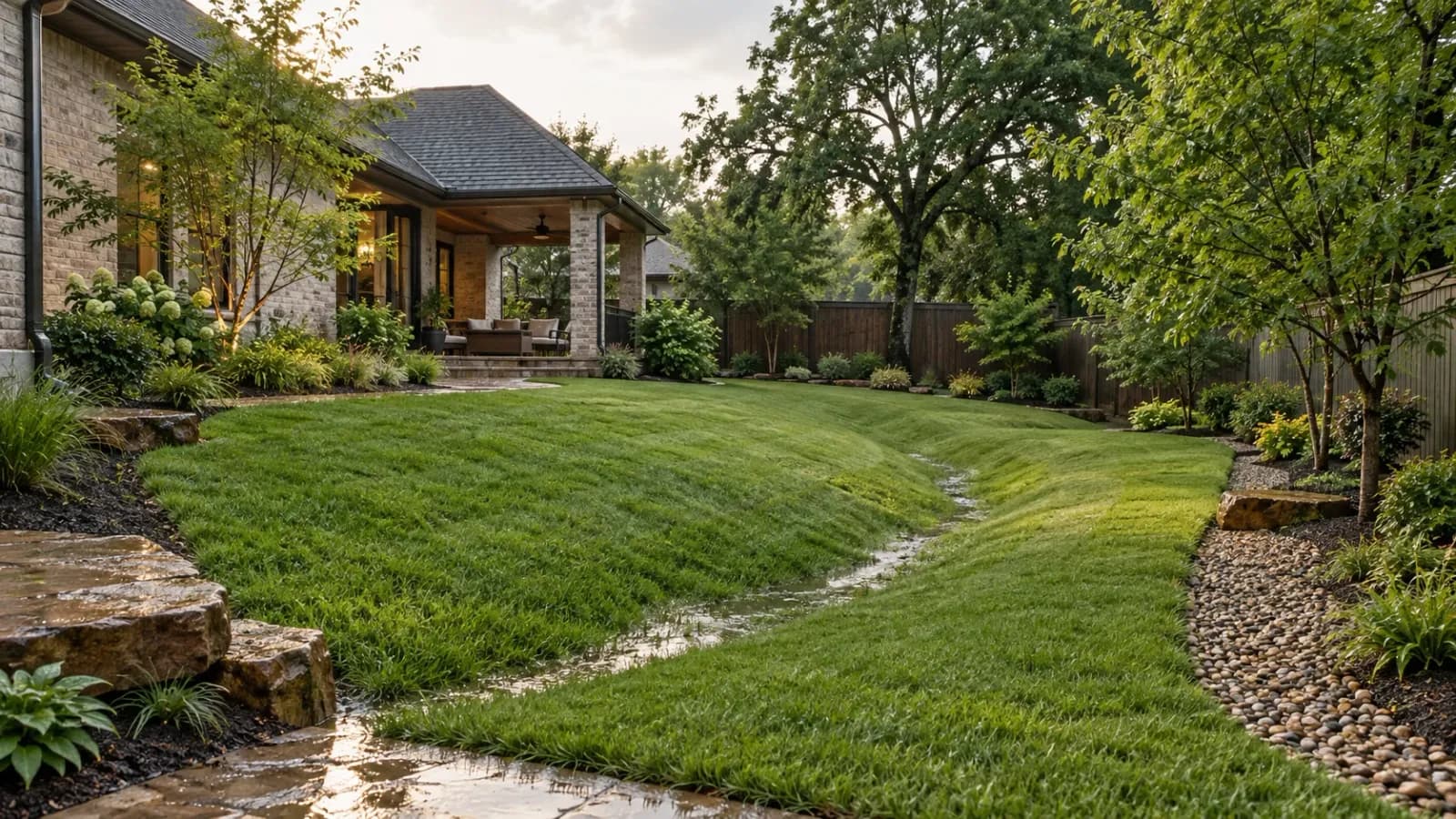
Regrading fixes water that runs across the surface in the wrong direction. A French drain fixes water the surface can't move: ground that stays soaked, water seeping up from below, or a spot with no room to build enough slope.
The U.S. Department of Energy's Building America guide puts the choice in one line. Where the grade is flat or tips toward the house and the lot has space, shape the ground into swales. Where space is tight, install drains. Plenty of Tulsa-area yards need some of each: a reshaped grade that steers most of the water, and a drain for the one corner the grade can't reach.
When regrading is the fix
Regrading means reshaping the soil so water runs where you want it. It's the first fix to check when you can watch the water during a storm: sheeting off the roof and patio, running toward the house, or collecting in a low spot.
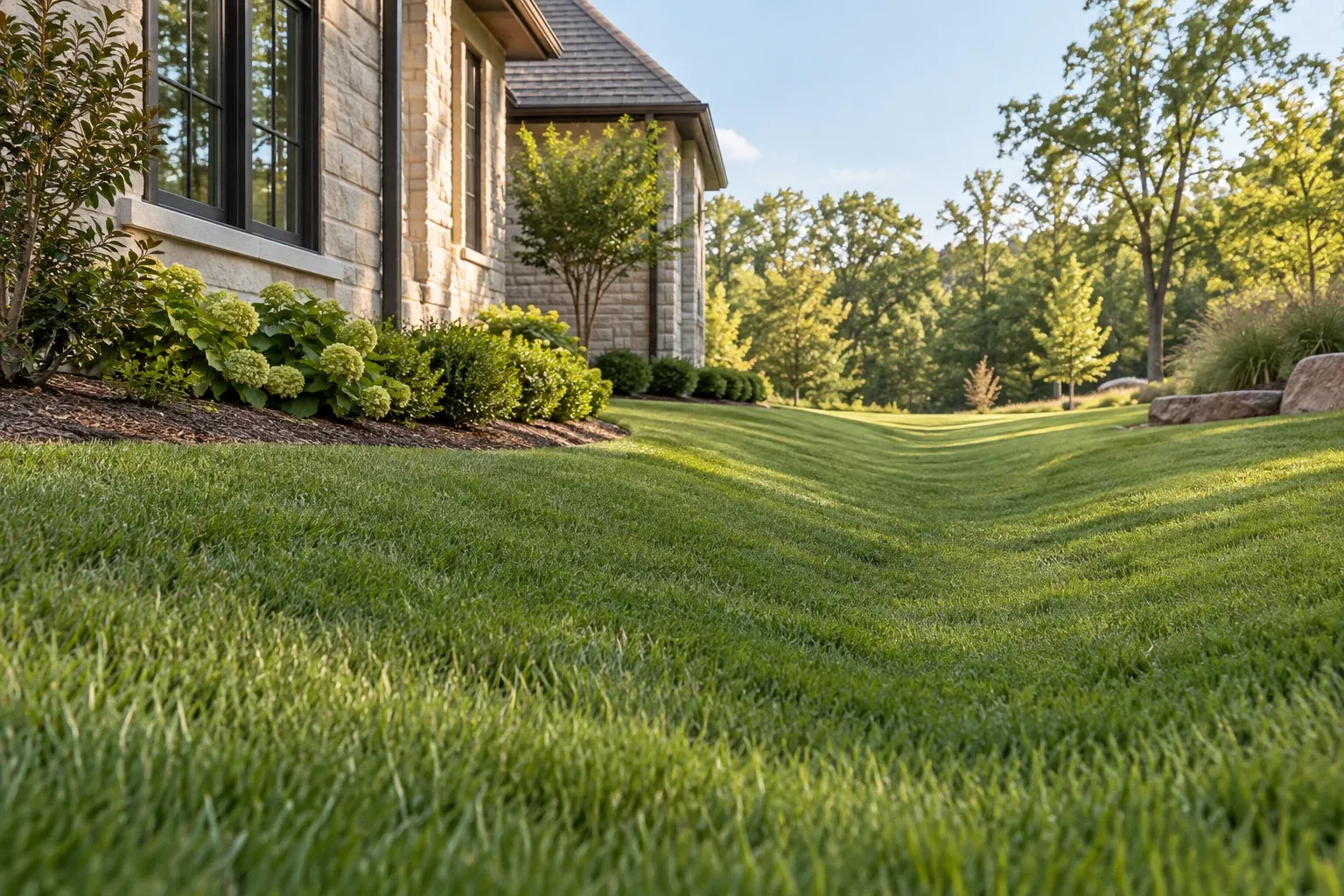
Oklahoma's residential code, the 2024 International Residential Code statewide since September 14, 2026, sets the target near a house. The ground must fall at least 6 inches in the first 10 feet away from the foundation. Paving within 10 feet must slope at least 2% away.
Regrading also covers swales: wide, shallow, grassed channels that carry water across the yard to an outlet. The Building America guide calls for a swale to fall 2% to 4% along its length, with sides no steeper than 3 to 1. Washington State University Extension says swales are often less expensive to install than underground drainage, and should be built to hold water no more than 48 to 72 hours.
Regrading works best when:
- Water runs over the surface instead of soaking up from below.
- The yard has enough length to build in the fall the code asks for.
- The water has somewhere downhill to go, such as the street or a drainage easement.
- The foundation shows enough above ground that new soil won't cover brick, siding or framing.
That last point limits a lot of older houses. Oklahoma State University Extension warns against building soil up against a house where brick, insulation or wood studs sit behind it, because those stay wet. Regrading moves the low point. It doesn't bury the siding.
When a French drain is the fix
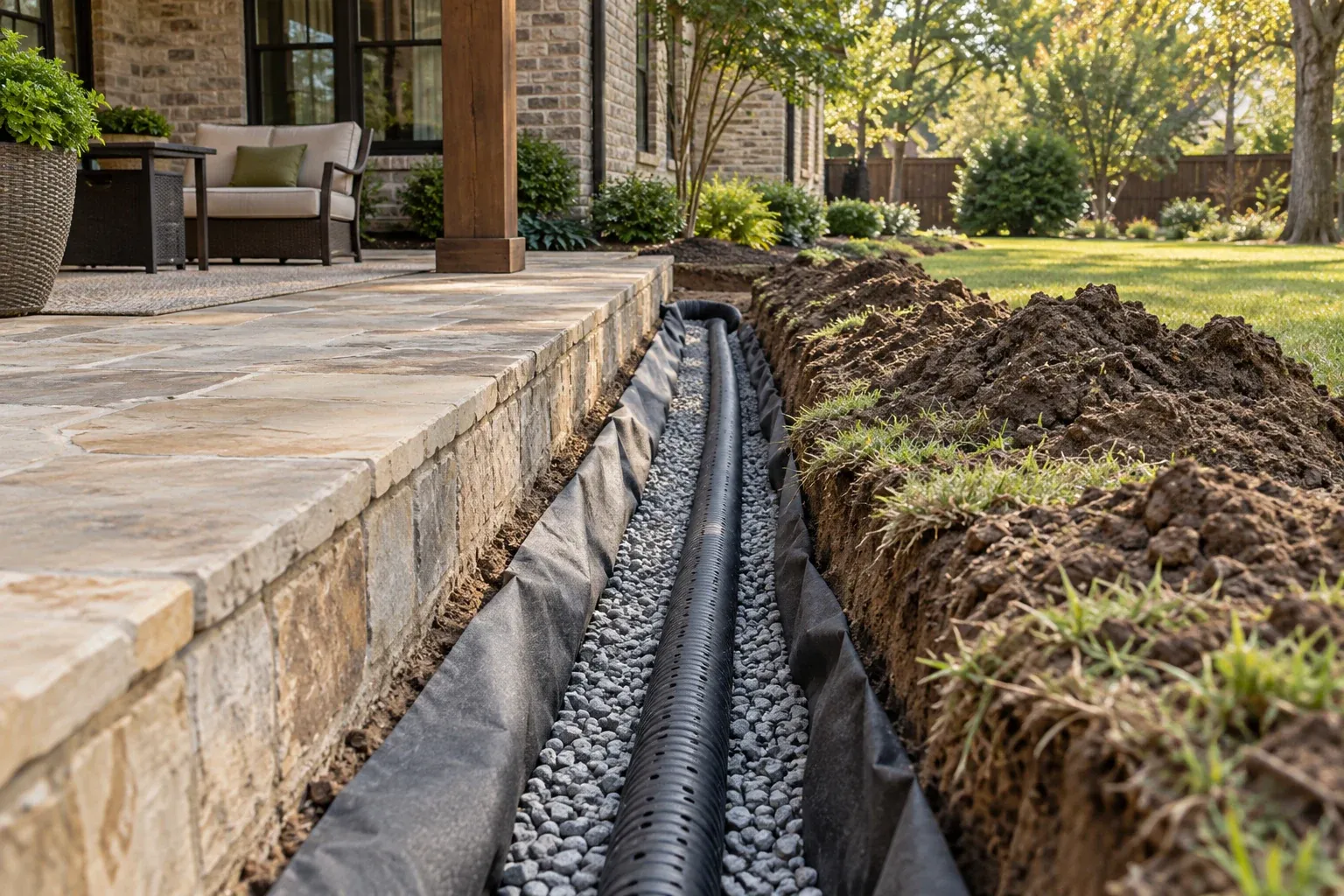
OSU describes the original French drain as a trench of permeable rock, such as 1.5-inch river rock, dug deep enough to carry water off and filled all the way to the surface. A subsurface drain is the version most yards get: perforated pipe in gravel, buried below the topsoil. OSU says a drain may be needed where water seeps up through the soil and leaves it muddy, squishy or fully saturated.
A drain makes sense when:
- The ground stays wet days after rain. Water moving through the soil, not over it, needs a pipe to collect it.
- There's no room for slope. Narrow side yards between houses rarely have 10 feet to drop 6 inches. The code's exception allows a 5% slope with the water sent to drains or swales.
- Water arrives from upslope. A drain on the uphill side of a wet area, which OSU calls an interceptor drain, catches the water before it reaches the house or lawn.
- Downspouts need somewhere to go. WSU Extension notes buried downspout lines can tie into a French drain.
How a French drain is built
Building America's steps run like this. Dig a trench at least 22 inches deep and 14 inches wide, sloped away from the house, and line it with filter fabric. Lay 4 inches of clean rock, then 4-inch perforated pipe with the holes facing down. Cover the pipe with 4 to 6 inches more rock, lap the fabric over the top, and finish with 9 inches or more of rock, topsoil or mulch. The guide also says to keep shrubs and trees off the line. WSU says the trench should fall 0.5% to 1% toward the outlet, where a 1-foot drop over 100 feet makes 1%. Building America prefers smooth PVC pipe to corrugated, which is more likely to collect sediment and clog.
Every drain needs an outlet lower than the drain. OSU lists three: a pipe that comes back to the surface downhill, a dry well, or a sump with a pump where the yard is too flat for gravity. WSU adds that a dry well needs soil that can soak up the water and should sit at least 10 feet from a foundation, which is worth checking on Tulsa-area clay. Where a pipe daylights, Building America says it should end on ground that slopes away from the building, with a splash block or stones to stop erosion.
Where drains fall short
A drain moves water. It doesn't make more room for it. Delaware's state environmental agency says French drains aren't recommended for areas that flood often because the yard has no slope, and that a simple yard drain may not stop seepage into a basement or crawlspace. OSU describes a homeowner whose French drain was overwhelmed in storms because the neighbors' runoff crossed the yard. For that case it suggests better grading, or a surface drain piped to the road.
OSU also notes soil works into every drain over time, so a good design leaves a way to clean it out.
What each costs
LawnStarter's cost guide, updated October 5, 2026, puts exterior French drains at $10 to $65 per linear foot, or $1,000 to $6,500 for a 100-foot run. Delaware's agency estimated, in 2022 dollars, $600 to $2,000 in materials for a shallow 60-foot drain a homeowner digs, and $1,000 to $4,000 installed for a deeper 60-foot drain. We found no published regrading range solid enough to cite. Regrading price depends on how much soil moves, whether topsoil comes in, how far the water must travel to an outlet, and how much sod or bed has to be replaced.
Rules before you dig
Inside Tulsa, the city's residential guidelines apply the grading and drainage plan requirement to regrading as well as new building. Every property must accept and pass along drainage without damaging its neighbors, can't block water flowing onto it from off-site, and must send its own extra water to the street or another approved outlet where possible. A fix that dumps water on the next lot breaks those rules. In Jenks, Bixby, Glenpool, Sapulpa or Sand Springs, ask your own city.
Both fixes mean digging, so call OKIE811 first. Locating buried lines is free, and a contractor has to contact 811 at least three business days before the work.
Common questions
Is a French drain better than regrading?
Neither wins everywhere. Regrading handles water running over the surface where there's room to build slope. A French drain handles soaked or seeping ground, or tight spaces with no room for slope. Many wet yards need both.
How much slope does a yard need away from the house?
Oklahoma's residential code requires the ground to fall at least 6 inches in the first 10 feet. Where a lot can't fit that, it allows a 5% slope with water sent to drains or swales, and swales within 10 feet of the foundation must fall at least 2%.
How deep should a French drain be?
The Department of Energy's Building America guide calls for a trench at least 22 inches deep and 14 inches wide, with the drain 18 or more inches below ground. Delaware's state environmental agency says deeper drains, or drains close to a foundation, need a drainage contractor.
How much slope does a French drain pipe need?
WSU Extension says 0.5% to 1% toward the outlet. At 1%, a pipe drops 1 foot over 100 feet. The outlet has to sit lower than every part of the drain.
Do I need a permit to regrade my yard in Tulsa?
The City of Tulsa's residential guidelines apply the grading and drainage plan requirement to regrading. Check with the city before reshaping a lot, and don't send extra water onto a neighbor's property.
Not sure which one your yard needs?
We handle French drains, regrading and downspout fixes in Jenks, Bixby, Glenpool, Sand Springs and Sapulpa. The visit starts with where the water comes from, where it collects and where it can safely leave, and the quote spells out which fix fits. See our drainage work or send photos taken during or just after rain.
Sources: U.S. Department of Energy Building America Solution Center (PNNL), Swales, Drains, and Site Grading for Stormwater Control · Oklahoma State University Extension, BAE-1542: Addressing Drainage Issues in the Urban Landscape (PDF, July 2020) · Washington State University Clark County Extension, Improving Drainage · Delaware DNREC, French Drain for Yard (PDF) · Oklahoma Uniform Building Code Commission, 2024 IRC adoption rule (PDF, effective September 14, 2026) · Maricopa County, Building elevation plan requirements (restates IRC R401.3 grading) · City of Tulsa, Residential Building Guidelines (PDF, January 2025) · LawnStarter, How Much Does a French Drain Cost? (updated October 5, 2026) · OKIE811, Homeowners