How much water does a Bermuda lawn need in an Oklahoma summer?
About 1 inch a week from May through September, rain included, per OSU. Water deeply once or twice a week in the early morning, not a little every day.
· Tulsa, Jenks, Bixby, Glenpool, Sapulpa, Sand Springs
The short answer
Give an established Bermuda lawn about 1 inch of water a week from May through September, counting rain. That's the most Oklahoma State University's Bermudagrass Lawn Management Calendar (L-441) projects the lawn will need in those months. It drops to half an inch a week in March, April, October and November. Put it down in one or two deep waterings a week, early in the day, not a short run every morning.
OSU calls those amounts estimates and says to cut back when it rains. Its test for when to water is simple: walk across the lawn, and if your footprints stay visible in the grass, it's time.
Why July and August need the hose
The National Weather Service's 1991-2020 normals for Tulsa put July rain at 3.76 inches and August at 3.38 inches, with normal highs of 93.6°F and 93.0°F. An inch a week works out to about 4.4 inches in a 31-day month, so an average July or August leaves the lawn short, and a dry one leaves it far short.
OSU's irrigation audit fact sheet (HLA-6610) shows the pattern with Oklahoma Mesonet data from Oklahoma County. There, Bermuda used 6.6 inches of water in July against 2.9 inches of average rain, leaving 3.7 inches to make up. May, with 5.4 inches of rain, needed nothing extra. Those numbers come from the Spencer Mesonet station in Oklahoma County, not Tulsa, but the fact sheet's general point fits here too: rain is often enough during the growing season, and dry spells in July and August are when a lawn needs irrigation.
Green or just alive
OSU's irrigation page separates two goals. Lawns typically need 1 inch a week to stay healthy and up to 2 inches a week to stay green in summer. Bermuda can be kept alive on less, but it may turn brown in a long drought. Pick your goal before you set the timer.
Water deep and less often
OSU's drought-prep fact sheet says to avoid light, frequent watering except on newly seeded areas, because deep, infrequent watering pushes roots deeper looking for moisture. OSU Extension's August 2026 gardening column puts it in one line: water deeply once or twice a week, depending on the soil.
Soil decides which. OSU's lawn watering tips say sandy soils need lighter, more frequent watering and clay soils need heavier, less frequent watering. HLA-6610 explains why: clay holds more water but takes it in slowly. That's the catch with clay. Apply water faster than it soaks in and it runs into the street, which OSU calls pouring money down the drain. If water reaches the curb before a zone finishes, split that run into two shorter ones with a break between.
Before you water, push a screwdriver into the lawn. OSU's tip: if it goes in easily, skip the watering.
When to water
OSU's lawn watering tips say to water before 10 a.m. The August 2026 column names early morning or late evening as the best times. Don't water when it's below 40°F, which matters for the half-inch weeks in spring and fall.
Measure what your sprinkler puts down
Most people guess at run times. HLA-6610 lays out a test that takes under an hour:
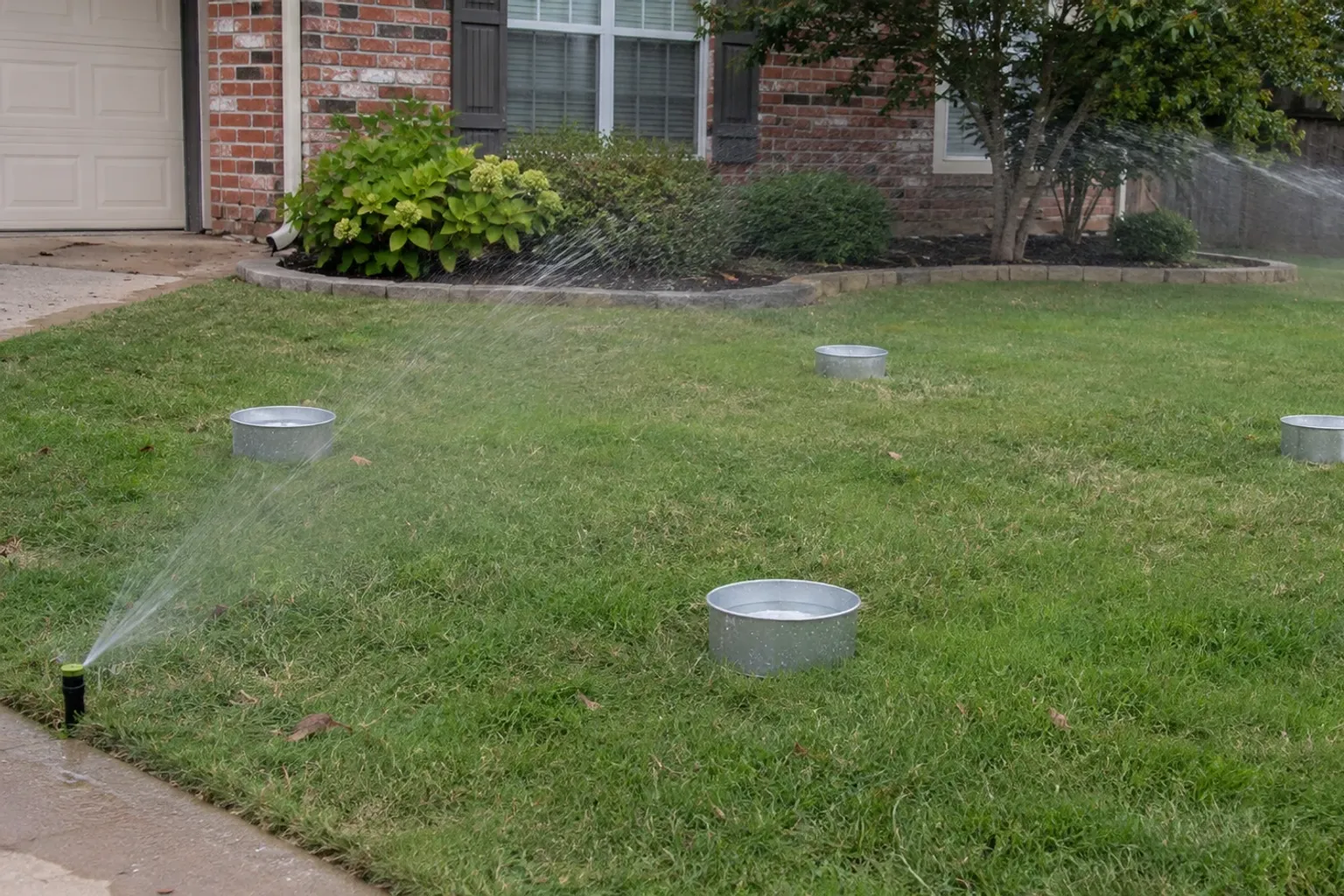
- Set nine identical cans (tuna, cat food or tomato paste cans work) in a square about 16 feet on a side, roughly 8 feet or three steps apart.
- Put a sprinkler at the middle of one side, or run your in-ground zone, for 20 minutes. With a hose sprinkler, move it to the opposite side and run another 20 minutes.
- Pour all nine cans into one and measure. Divide by nine, then multiply by three. That's your output in inches per hour.
The fact sheet's examples show why it's worth doing. A system that puts out 0.2 inch an hour delivers only a tenth of an inch in a 30-minute run. One that puts out 0.6 inch an hour, set for an hour every day, applies 4.2 inches a week, about four times what an established Bermuda lawn needs. If some cans fill and others stay nearly dry, the coverage is uneven, and the dry spots in your lawn will show it.
For scale, HLA-6610 works out that an inch of water on a 5,000-square-foot lawn is 3,123 gallons.
When the city limits watering
Area cities can restrict outdoor watering in a shortage, and summer is when they do. On August 19, 2026, Bixby put odd-numbered addresses on Monday, Wednesday and Friday and even-numbered addresses on Tuesday, Thursday and Saturday, with watering only from 6 p.m. to 6 a.m., through September 18.
Sand Springs' code ties its rules to the City of Tulsa's. When Tulsa declares Stage Two, Sand Springs splits the city into five groups by the last digit of the address, and each group waters lawns every fifth day, between midnight and noon or between 6 p.m. and midnight. In Stage Three, watering is by handheld hose only.
A deep, once-a-week schedule fits inside rules like these better than daily watering does. Check your city's notices in July and August.
Let it go tan, or keep it green
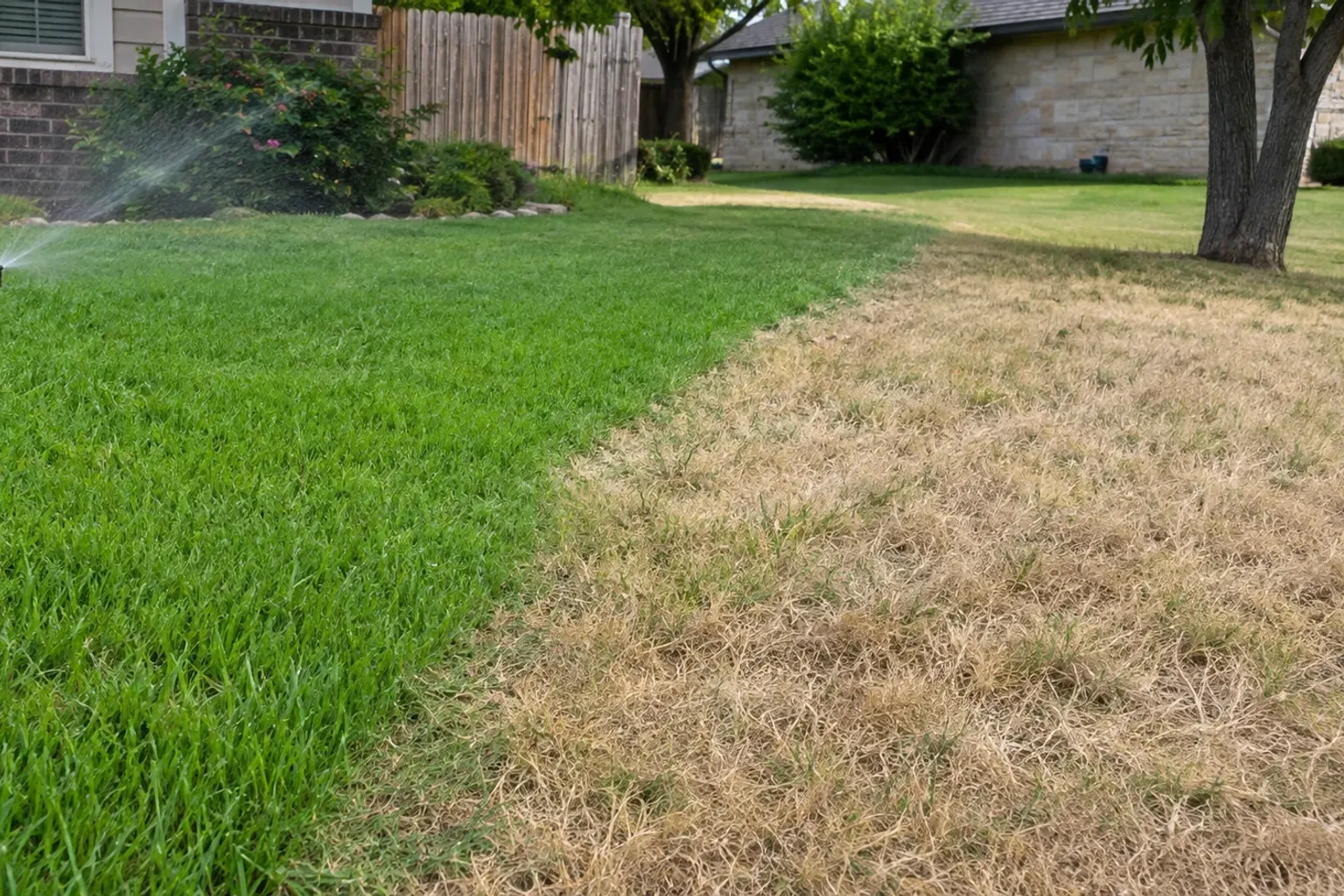
You can let an established Bermuda lawn ride out a dry spell. OSU's turf FAQ says common Bermuda can often survive several weeks while tan, with minimal to moderate thinning, and resume growth when moisture returns. The L-441 calendar suggests a non-irrigated brown Bermuda lawn as a way to save community water during severe drought.
If you do, give it the best odds. OSU's drought-prep sheet puts the ideal mowing height for warm-season grass at 2 to 3 inches and never remove more than a third of the blade, and the August 2026 column says not to fertilize during drought.
Common questions
How long should I run my sprinklers for Bermuda grass?
Long enough to put down your weekly half inch to inch in one or two runs. Do the nine-can test from OSU's HLA-6610 to find your output in inches per hour. At 0.5 inch an hour, an inch takes two hours a week, split into two one-hour runs or broken up further on clay.
Should I water Bermuda grass every day in summer?
No. OSU's extension guidance is to water deeply and infrequently, once or twice a week depending on soil, and to avoid light, frequent watering except on new seed.
Will Bermuda grass come back after turning brown in a drought?
Usually, if it was established and healthy. OSU's turf FAQ says common Bermuda can survive several weeks while tan and resumes growth when moisture is available again.
Is it better to water Bermuda in the morning or at night?
Morning. OSU's lawn watering tips say to water before 10 a.m. Its August 2026 column also lists late evening, which is the only option when a city limits watering to overnight hours.
Keeping an eye on the water
A sprinkler head that's broken or aimed at the driveway can waste water for weeks before anyone notices. Our Plus and Premier lawn care plans include irrigation checks: a look at coverage and visible problems so dry patches and wasted water don't go unnoticed. Repairs are scoped separately. Send us a few photos and we'll put the work and the price in writing.
Sources: Oklahoma State University Extension, Bermudagrass Lawn Management Calendar (L-441, PDF) · Oklahoma State University Extension, Simple Irrigation Audit for Home Lawns in Oklahoma (HLA-6610, PDF) · Oklahoma State University Extension, Irrigation · Oklahoma State University Extension, Lawn Watering Tips · Oklahoma State University Extension, Preparing Your Lawn for Drought · Oklahoma State University Extension, Turf Grass FAQ · Oklahoma State University Extension, Grow column, August 30, 2026 · National Weather Service Tulsa, July climate normals · National Weather Service Tulsa, August climate normals · KJRH, City of Bixby issues mandatory water conservation notice (August 2026) · City of Sand Springs, Title 13 Public Utilities (PDF)