Paver patio vs. concrete patio for Oklahoma clay
Concrete costs less up front but cracks when clay moves. Pavers flex with the ground and lift out for repair. On clay, the base decides how either one lasts.
· Tulsa, Jenks, Bixby, Glenpool, Sapulpa, Sand Springs
The short answer
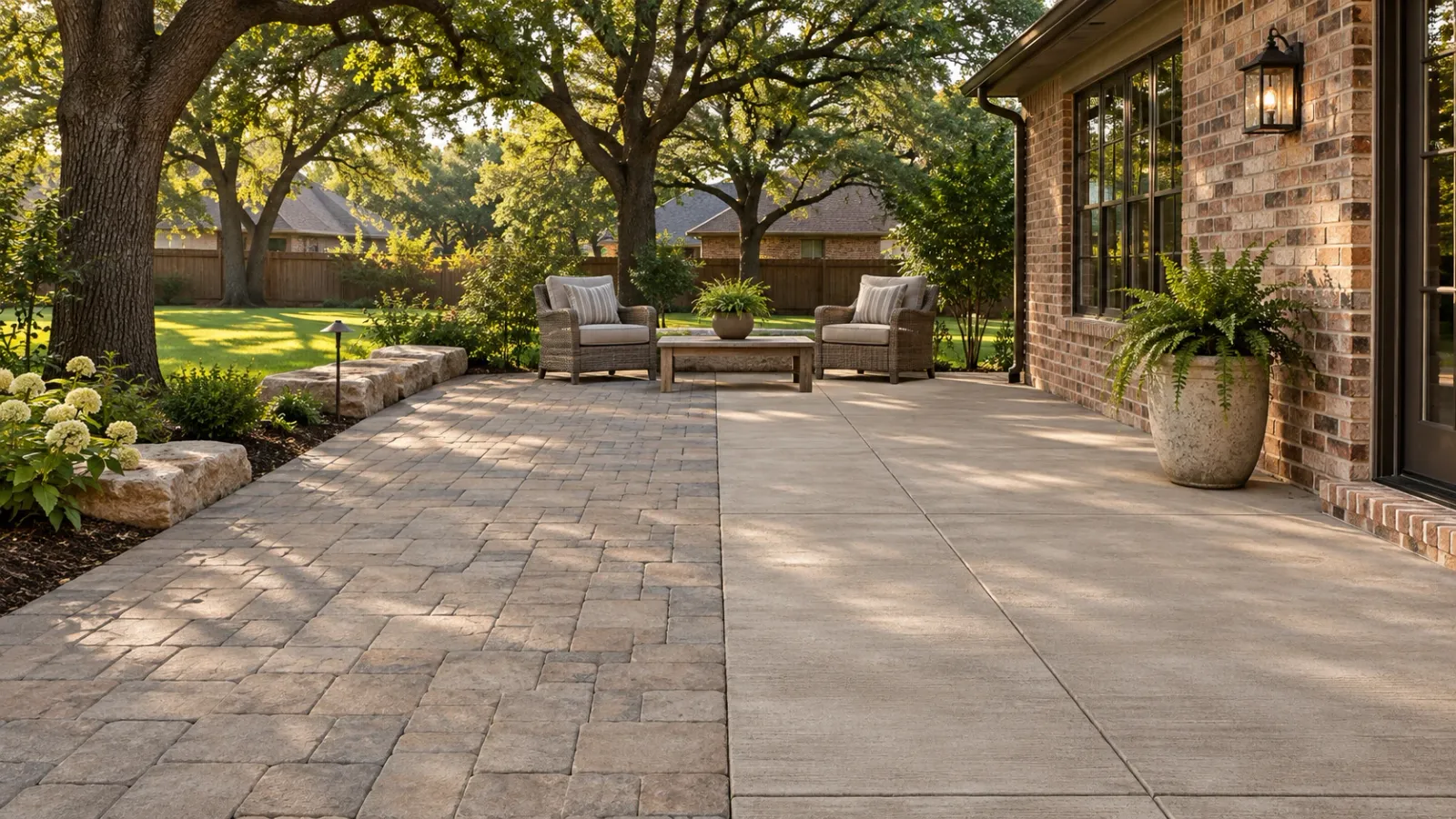
A poured concrete patio costs less up front. A paver patio costs more but handles moving clay better: it bends with the ground instead of cracking, and a sunken or heaved section can be lifted out and relaid. Fixr's cost guide puts poured concrete at $6 to $17 per square foot installed and pavers at $10 to $25.
On Tulsa-area clay, the bigger choice sits under the surface. A slab poured on a poor subgrade cracks, and pavers laid on a thin base settle. Pick the surface you want to look at, then pay for the ground work that keeps it flat.
Why clay changes the question
Much of the ground around Tulsa is expansive clay. The City of Tulsa's hazard plan describes clays that swell as they absorb water and shrink as they dry, and says those movements crack and buckle what's built on them. Lowlands along the river tend to have low shrink-swell soils. Many higher elevations, including large areas of central and east Tulsa, have moderate to high potential. The plan counts 22,920 improved parcels in Tulsa on soils with high to very high shrink-swell potential, and ties the damage to cycles of drought and heavy rain.
A patio is a thin, wide surface sitting on top of that soil. It moves when the ground under it moves. The two materials react to that movement in very different ways.
How a concrete patio handles clay
Concrete is one rigid piece. The National Ready Mixed Concrete Association (NRMCA) says concrete is weak in tension and shrinks as it dries, and that cracks can't be prevented entirely, only controlled. Its guide to slab cracking lists the usual causes: missing or badly placed joints, poor subgrade preparation, too much water in the mix, poor finishing, and too little curing. Settlement cracks are on its list too.
Control joints decide where a slab cracks. NRMCA's rules for slabs on grade:
- Space joints no more than 24 to 36 times the slab thickness. For a 4-inch slab that's about 10 feet, and never more than 15.
- Keep panels square or close to it, no longer than 1.5 times their width, and avoid L-shaped panels.
- Cut or tool each joint at least a quarter of the slab's depth.
- Put an isolation joint where the patio meets the house, steps or a walk.
NRMCA also says wire mesh won't stop cracking. It holds cracks tighter once they form.
Freezes matter here as well. Tulsa's average first hard freeze (28°F) comes November 14 and its average last one March 17, according to the National Weather Service. NRMCA calls for air-entrained concrete on outdoor slabs exposed to freezing weather, at about 6% air for mixes with ¾- or 1-inch stone. Without it, a wet slab that freezes can flake at the surface, which NRMCA calls scaling. Deicing salt makes it worse.
Lawn Love's cost guide calls 4 inches the standard thickness for a concrete patio.
How a paver patio handles clay
The Concrete Masonry & Hardscapes Association (CMHA) describes a paver patio as a flexible pavement. Pavers sit on about 1 inch of bedding sand over a compacted gravel base, with sand swept into the joints so the units lock together. CMHA says those joints help reduce the cracking typical of poured concrete, and that a small amount of settling is normal in any flexible pavement.
The flexibility only helps if the base is right. CMHA's construction guide calls for at least 4 inches of compacted base under patios on well-drained soil, more on wet or weak soil, and lists a geotextile fabric over clay so the soil can't work up into the gravel. Unilock, a paver maker, says clay bases generally need to be dug deeper to drain.
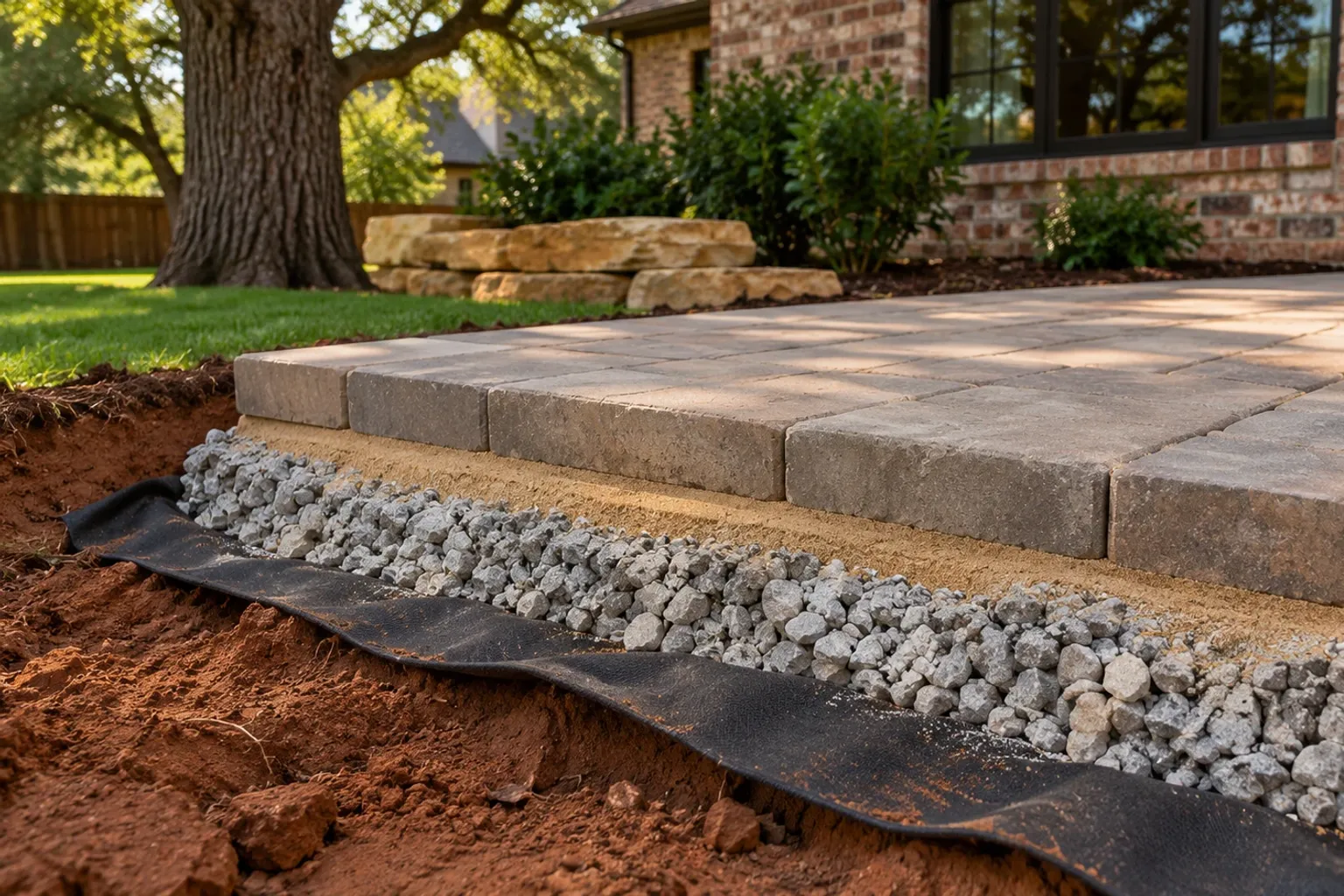
Repairs are the strongest argument for pavers. CMHA says the same pavers can be lifted out and reinstated after a low spot in the base is fixed or a line is run underneath. Unlike poured concrete, it notes, that takes no jackhammer and leaves no patch.
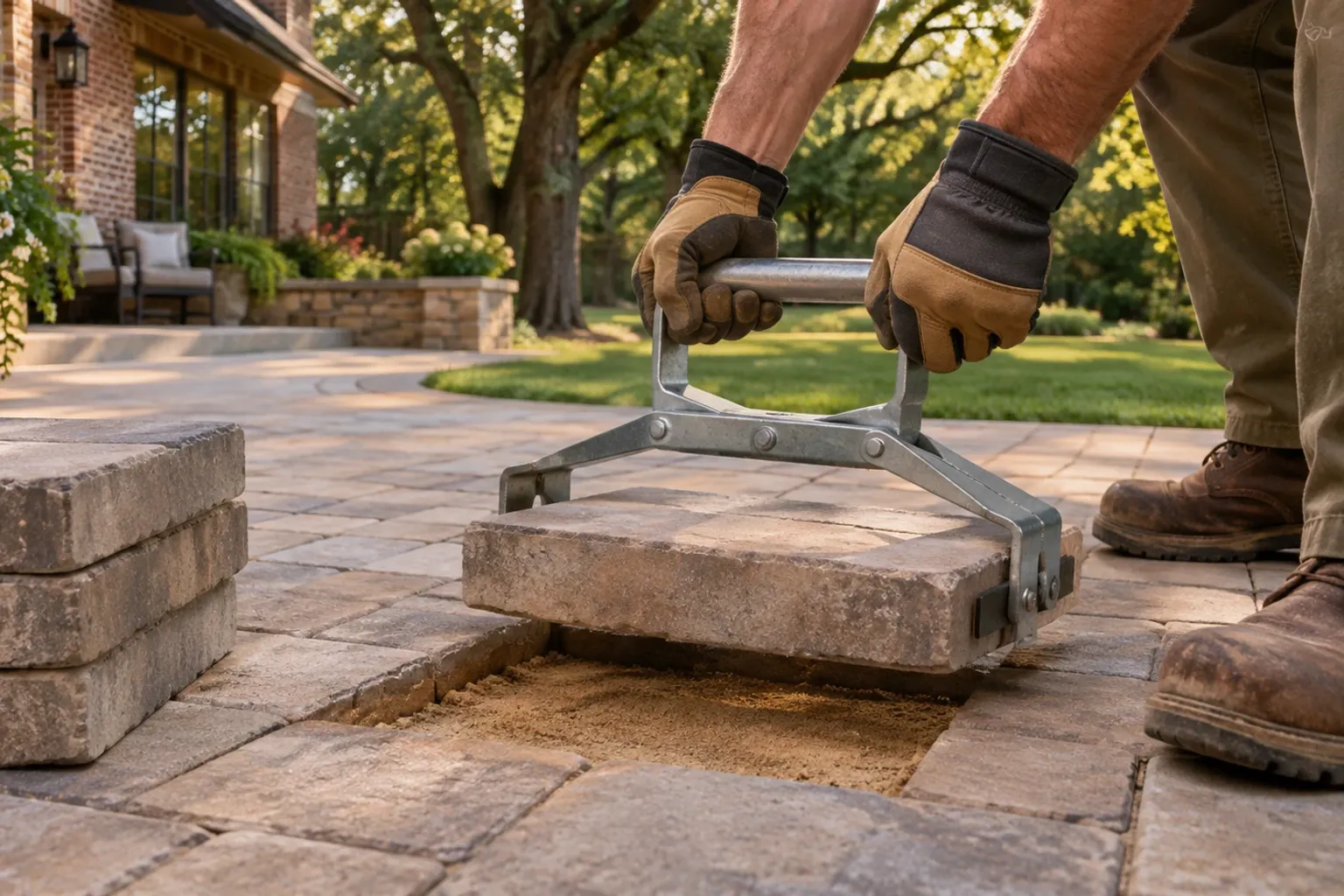
Concrete pavers made in the U.S. should meet ASTM C936. CMHA lists its main requirements: an average compressive strength of at least 8,000 psi, absorption of no more than 5%, and a freeze-thaw durability test.
Not every source agrees. Fixr's guide suggests poured concrete where soil shifts, and an engineer if you're worried about the ground. Either way, the fix starts below the surface.
Upkeep
- Concrete: Lawn Love says to seal a concrete patio every 3 to 5 years. Watch for cracks that keep widening.
- Pavers: CMHA recommends sweeping in spring and fall and checking the surface after a rain. Top up the joint sand once it has dropped more than ½ inch. Stabilized joint sand, laid during the build, helps keep joints full.
Either surface needs to drain. Oklahoma's residential code, the 2024 International Residential Code statewide since September 14, 2026, requires hard surfaces within 10 feet of the house to slope at least 2% away from it. That's about 2½ inches of fall over 10 feet, and it keeps water off the clay next to the foundation.
What each costs
National cost guides, not Tulsa quotes:
| Surface | Installed cost per sq. ft. | Source |
|---|---|---|
| Plain concrete slab | $4 to $9 | Lawn Love, October 2026 |
| Poured concrete patio | $6 to $17 | Fixr, 2022 |
| Concrete pavers | $10 to $25 | Fixr, 2022 |
| Stamped concrete | $15 to $30 | Fixr, 2022 |
Lawn Love puts the average concrete patio at $2,925, with most between $1,580 and $4,465. Our paver patio cost guide breaks down paver pricing by size and material. On clay, extra base depth, fabric or a drain line adds to either one.
Which one fits your yard
Concrete makes more sense when the budget is tight, the area is simple and rectangular, and the ground is stable and drains. Pavers make more sense when the yard sits on shrink-swell clay, the patio may need to change later, or you want to repair a section without replacing the whole thing.
Check permits before you pour. Glenpool requires a permit for concrete flatwork over 200 square feet, and the slab can't sit closer to the side lot line than the house, or 5 feet. In Tulsa, start with our patio and pergola permit guide.
Common questions
Is a paver patio better than concrete on clay soil?
Pavers handle moving clay better because the joints let the surface flex and a low spot can be lifted and relaid. Concrete costs less up front. On clay, either one depends on a well-compacted base and good drainage.
Will a concrete patio crack in Oklahoma?
Most concrete cracks somewhere. NRMCA says cracks can be controlled but not prevented entirely. Joints spaced no more than about 10 feet apart on a 4-inch slab, a compacted subgrade and air-entrained concrete keep cracks in planned places.
How much more do pavers cost than concrete?
Fixr puts a poured concrete patio at $6 to $17 per square foot installed and pavers at $10 to $25. Lawn Love lists a plain gray slab at $4 to $9 per square foot.
How thick should the base be under pavers on clay?
CMHA calls for at least 4 inches of compacted base on well-drained soil and more on wet or weak soil. Unilock says clay generally needs deeper digging, with geotextile fabric under the gravel.
Can you put pavers over an old concrete patio?
CMHA describes overlays where pavers sit on bedding sand over an existing concrete base. Cracks 3/8 inch or wider should be patched first, and the bedding sand needs drain holes. On expansive clay, CMHA says those holes have to be piped to an outlet.
Talk it through on site
We build paver patios in Jenks, Bixby, Glenpool, Sand Springs and Sapulpa. Each written quote sets out the base depth, the fabric and the slope for your soil before work starts. See how we build paver patios or send us photos of the space.
Sources: City of Tulsa, 2019 Hazard Mitigation Plan (PDF), Section 4.10 Expansive Soils · National Ready Mixed Concrete Association, CIP 4: Cracking Concrete Surfaces (PDF) · NRMCA, CIP 6: Joints in Concrete Slabs on Grade (PDF) · NRMCA, CIP 2: Scaling Concrete Surfaces (PDF) · National Weather Service Tulsa, Frost/Freeze Climatology · Concrete Masonry & Hardscapes Association, PAV-TEC-002: Construction of Interlocking Concrete Pavements · CMHA, PAV-TEC-010: Application Guide for Interlocking Concrete Pavements · CMHA, PAV-TEC-006: Operation and Maintenance Guide for Interlocking Concrete Pavement · Unilock, Dos and don'ts of paver installation: base preparation · Fixr, Patio Cost (updated August 19, 2022) · Lawn Love, How Much Does a Concrete Patio Cost in 2026? (updated October 5, 2026) · Oklahoma Uniform Building Code Commission, 2024 IRC permanent rule (PDF, effective September 14, 2026) · Maricopa County, Building elevation plan requirements (restates IRC R401.3 grading) · City of Glenpool, Required Residential Permits (PDF)