Landscape lighting basics for Tulsa-area homes
Most yard lighting is a 12-volt LED system run from a plug-in transformer, with cable buried 6 inches deep. National installed prices run $2,000 to $4,900.
· Tulsa
The short answer
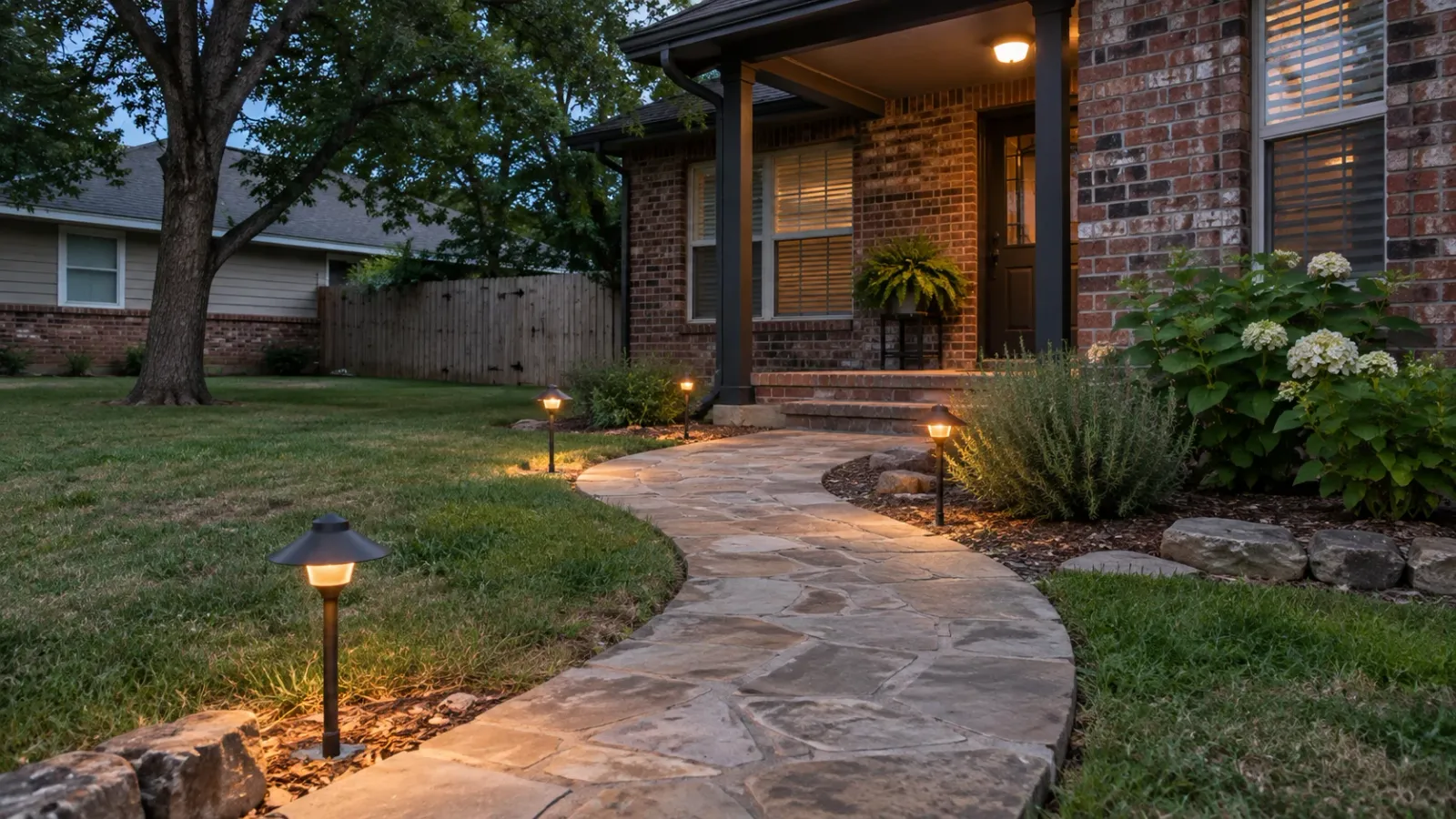
Most landscape lighting is a low-voltage system: a transformer plugs into an outdoor GFCI outlet, steps your house's 120 volts down to 12, and feeds LED fixtures through direct-burial cable laid at least 6 inches deep. Kichler, a lighting maker, gives those numbers in its transformer instructions. National cost guides put a professionally installed system at $2,000 to $4,900, or $100 to $200 per fixture.
The planning that decides whether it looks good happens before anyone digs: what you want lit, where the transformer goes, and how the wire runs.
The four parts
VOLT, another lighting maker, breaks every low-voltage system into four parts:
- Transformer. The power supply. It plugs into an outdoor outlet and lowers the voltage. Kichler says to mount it at least 12 inches above the ground and within 8 feet of a GFCI outlet, ideally on its own breaker circuit.
- Fixtures. Path lights, spotlights, well lights and the like, with built-in LEDs or replaceable bulbs.
- Direct-burial cable. The wire from the transformer to the fixtures, sized by gauge.
- Connectors. Where each fixture's short lead joins the main cable.
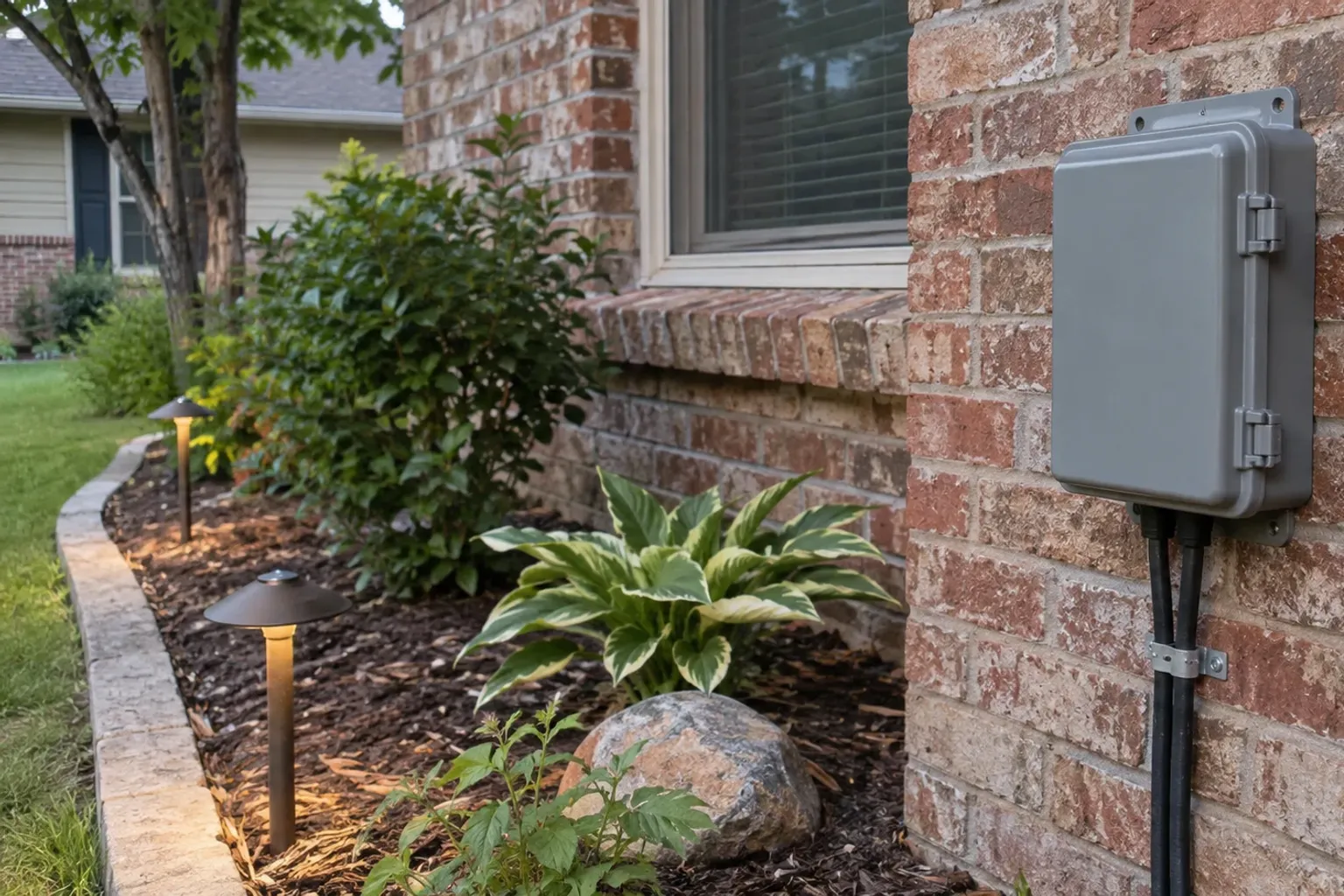
Most transformers can switch on with a photocell at dusk, a timer, or a phone app. Kichler notes that a photocell has to sit where no light shines on it, or it will cycle on and off.
Start with what you want to see
VOLT suggests deciding first what the lights are for: safety on steps and paths, security, showing off trees and the house, or using the patio after dark. That list sets the fixture count. Lawn Love's cost guide says a standard residential walkway takes about 8 to 10 path lights, and gives a rule of thumb of one light every 6 to 8 feet.
Walk the yard at night before you buy anything. Mark each fixture spot with a flag, then sketch the yard with the house, beds, walks and trees, and measure from the transformer to each flag. VOLT says those measurements become your wire lengths.
Sizing the transformer and wire
Transformer. Add up the watts of every fixture. Kichler says the total should not exceed the transformer's rating and, as a rule, should not be less than a third of it. VOLT says most makers recommend using no more than 80 percent of the rating. Its example: 20 LED fixtures at 5 watts each is 100 watts, which fits a 150-watt transformer (150 × 0.8 = 120).
Wire. Voltage drops along a cable, so the last light on a long run gets less power than the first. VOLT's rule: multiply the watts on a run by its length in feet. At 10,000 or less, 12-gauge cable works. From 10,001 to 15,000, use 10-gauge or split the run in two. It also suggests keeping each run around 100 to 150 watts and grouping fixtures at similar distances from the transformer.
Voltage at the fixture. Kichler wants more than 10 volts at the last fixture on a run and says to check every fixture is getting 9 to 15 volts with a voltmeter. Halogen bulbs are fussier: VOLT says they need 10 to 12 volts, while its LED fixtures run on 8 to 15. That range is one reason LED systems are easier to wire.
LED or halogen
Go LED. LawnStarter's cost guide says LED bulbs last 25,000 to 40,000 hours and cost less to run than halogen or incandescent. Lower wattage also means a smaller transformer, thinner wire and less voltage drop.
Color matters too. DarkSky International recommends 2700K or lower for the most night-friendly light, and says a bulb at a higher color temperature, such as 3000K, should be well shielded, aimed carefully and on a timer or sensor.
Being a good neighbor
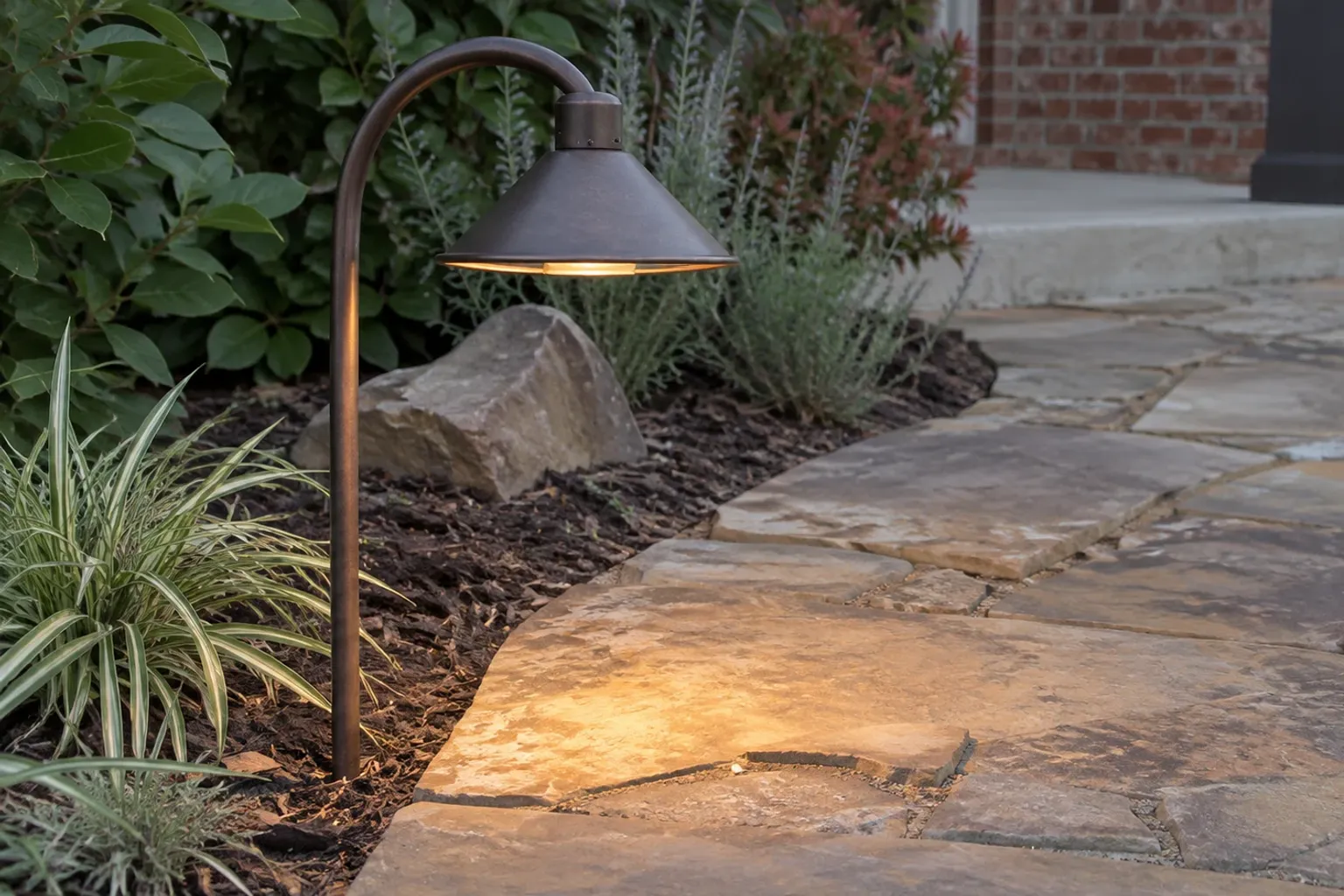
DarkSky's five principles for outdoor light are: useful, targeted, low-level, controlled and warm-colored. In practice that means aiming and shielding fixtures so light lands where it's useful, keeping path lights at 300 lumens or less (DarkSky's number), and running everything on a timer or photocell.
In the City of Tulsa, the zoning code's outdoor lighting chapter (Chapter 67) sets shielding and spillover limits, but it exempts lots with residential buildings of fewer than 4 dwelling units, fixtures of 1,000 lumens or less, and temporary holiday displays. So a typical house isn't bound by it. Its standard is still a fair test: the code asks that the light-producing part of a fixture not be visible from the next lot, measured 5 feet above the ground. If you live in a neighborhood with an HOA, check the covenants too.
Digging and power
Cable trenches are shallow, but they still cross gas, power and cable lines. Call 811's Oklahoma page says to notify Okie811 at least 48 hours ahead, not counting the day you call, weekends or legal holidays, and no more than 14 days before you dig. Marks last up to 14 calendar days.
The 12-volt cable is the easy part. The 120-volt side is where the rules sit. Kichler says the transformer must plug into a weatherproof GFCI outlet marked for wet locations, not an extension cord, and that wiring run through a building wall must be in conduit. VOLT recommends mounting the transformer outdoors for that reason. If the house has no outdoor outlet where you need one, adding it is electrical work. Tulsa's residential guidelines say electrical permits are taken out by the trade contractors doing the work.
What it costs
National figures, not Tulsa quotes:
| Item | Cost | Source |
|---|---|---|
| Typical installed system | $2,000 to $4,500 (average $3,250) | LawnStarter, updated October 23, 2026 |
| Typical installed system | $2,100 to $4,900 (average $3,500) | Lawn Love, updated December 27, 2025 |
| Per installed fixture | $100 to $200 | Both |
| 10 to 20 fixtures | $1,000 to $2,000 | Both |
| More than 40 fixtures | Over $5,000 | Both |
| Walkway, 8 to 10 path lights | $400 to $1,500 | Lawn Love |
| New outdoor outlet | $250 to $400 | Lawn Love |
Fixture material, the number of fixtures, wire length and whether a new outlet is needed move the price most. Solar stake lights cost less up front but, as Lawn Love notes, may not give as much light.
Common questions
How deep do you bury landscape lighting wire?
Kichler's instructions say to bury direct-burial cable at least 6 inches below the surface. Call Okie811 at least 48 hours before you dig, not counting weekends and legal holidays.
What size transformer do I need for landscape lighting?
Add up the watts of every fixture and pick a transformer rated above that total. VOLT says most makers recommend loading a transformer to no more than 80 percent of its rating, so 100 watts of LEDs fits a 150-watt unit.
What color temperature is best for landscape lighting?
DarkSky International recommends 2700K or lower. If you use 3000K, it says to shield the fixture, aim it carefully and put it on a timer or sensor.
Does Tulsa have rules for outdoor lighting at a house?
Tulsa's zoning code has an outdoor lighting chapter, but it exempts lots with residential buildings of fewer than 4 dwelling units and fixtures of 1,000 lumens or less. HOA covenants may still apply.
How much does landscape lighting cost?
National guides put a professionally installed system at $2,000 to $4,900, or about $100 to $200 per fixture. Ten to 20 fixtures run about $1,000 to $2,000.
Planning a patio or pergola?
Lighting is cheapest to plan before the hardscape goes in, when cable can run under the patio base instead of around it. We build patios, pergolas and fire features in Jenks, Bixby, Glenpool, Sand Springs and Sapulpa, and lighting added to the frame is one of the choices we price on a pergola. See how we build pergolas, see how we build patios, or send us photos of the yard. Our pergola materials guide and outdoor kitchen planning guide cover the rest of the plan.
Sources: Kichler, Transformer installation instructions IS-15PR100-US (PDF) · Kichler, Calculating Your Project Load Size · VOLT Lighting, How to Create a Landscape Lighting Installation Plan · DarkSky International, Home Outdoor Lighting Assessment (PDF, 2025) · Tulsa Zoning Code, Chapter 67 Outdoor Lighting (PDF) · City of Tulsa, Residential Building Guidelines (PDF, January 2025) · Call 811, Oklahoma · LawnStarter, How Much Does Landscape Lighting Cost in 2026? (updated October 23, 2026) · Lawn Love, How Much Does Landscape Lighting Cost in 2026? (updated December 27, 2025)