
Signs your retaining wall is failing
A wall that leans forward, bulges, opens gaps or has cracked, sinking ground behind it is moving. Most failures trace back to water held behind the wall.
· Tulsa
The short answer
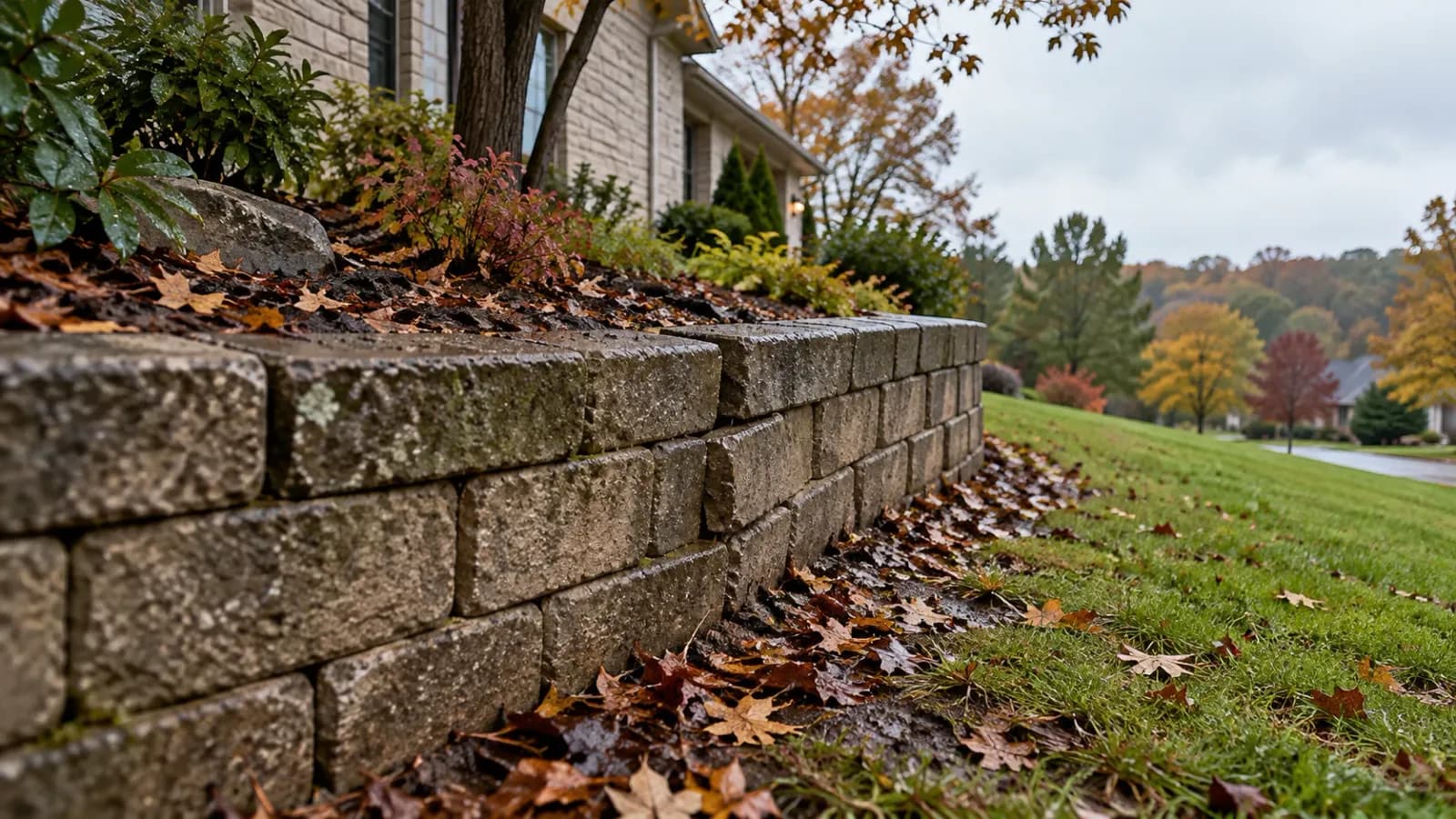
A retaining wall is failing when it moves. The signs to look for: the top leaning forward, a bulge in the face, blocks pushed out of line or gaps opening between them, cracks or holes in the ground along the top, and soil swelling out at the bottom. Water leaking through the face or pooling behind the wall belongs on the same list.
One crack or a little white powder on the block is usually cosmetic. A wall that keeps moving season after season is not, and the fix almost always starts behind the wall, where the water is.
The warning signs, one by one
New York City's Department of Buildings tells owners to get an engineer's opinion if they see any of these:
- The wall leaning out of alignment.
- Cracks or holes in the soil or paving along the top of the wall.
- Soil or paving swelling at the bottom of the wall.
- Severe cracks, bulging or displaced material in the wall.
- Water collecting behind or on top of the wall.
- Water leaking through cracks or clogged weep holes.
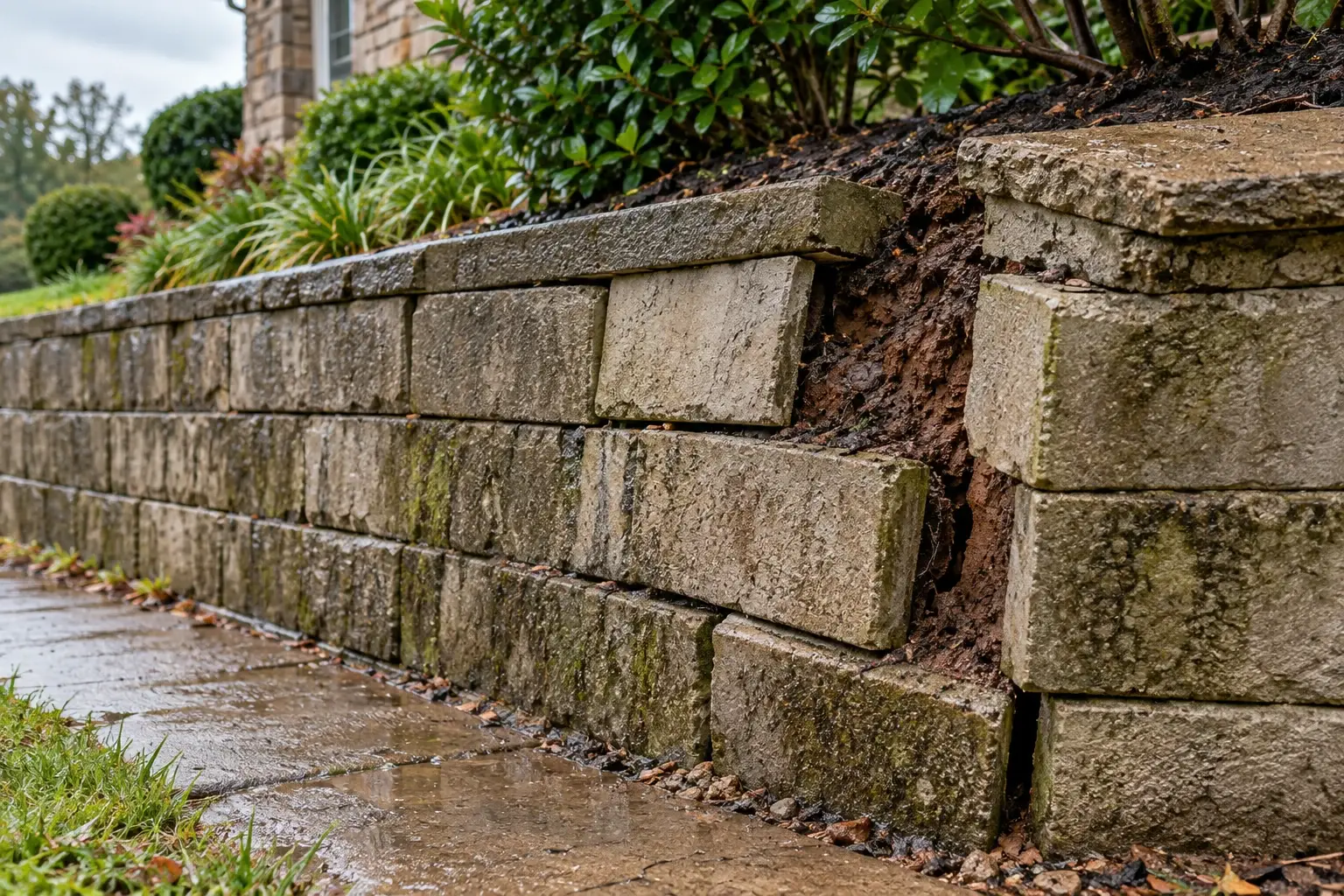
The Indiana Department of Transportation's inspection checklist adds detail by wall type. For timber walls, it marks decay, splitting and bulging as among the most likely problems. For masonry walls, it flags mortar breaking down, stones or blocks pushed out of place, bulging and sections separating.
Which way is it leaning?
Segmental block walls are built leaning back into the slope on purpose. The Concrete Masonry & Hardscapes Association explains that a gravity block wall holds the soil through its own weight and that backward tilt, called batter. So a wall that tips back is normal. A wall that tips toward you is not.
The U.S. Department of Housing and Urban Development's inspection standard draws the same line: a wall 24 inches or taller that leans away from the soil it holds is a deficiency, and one that leans back into the fill is not. Its inspectors look at the wall while standing parallel to it to judge whether it stands upright.
Allan Block, a block manufacturer, lists construction tolerances for its walls: within 1.25 inches over any 10 feet, both up and down and along the line of the wall, and within 2 degrees of the planned batter. It tells owners to call a contractor or an engineer at any sign of significant forward movement or rotation.
What a crack means, and what it doesn't
Not every crack is a failure. The concrete industry's Segmental Retaining Walls Best Practices Guide says a cracked block can be an eyesore without weakening the wall, and that industry practice accepts a small share of cracked units in a wall. Its limit is on gaps: the space between blocks should never be wider than half the size of the gravel behind them, or the gravel can wash out through the face.
Corners and tight curves are where gaps show first. The same guide explains that taller walls with poor backfill or weak compaction push outward under soil pressure, and at a corner that movement pulls the blocks apart. The cracks tend to show in the bottom third of the wall.
White, chalky staining is efflorescence: salt carried to the surface by water. Allan Block calls it usually harmless, but says it can be a warning sign of a structural problem. If it keeps coming back in the same spot, look at where the water comes from.
Why walls fail: water first
The best practices guide calls poor water management a frequent source of problems with any retaining wall. Water adds load behind the wall, erodes the soil around it and weakens the soil it stands in.
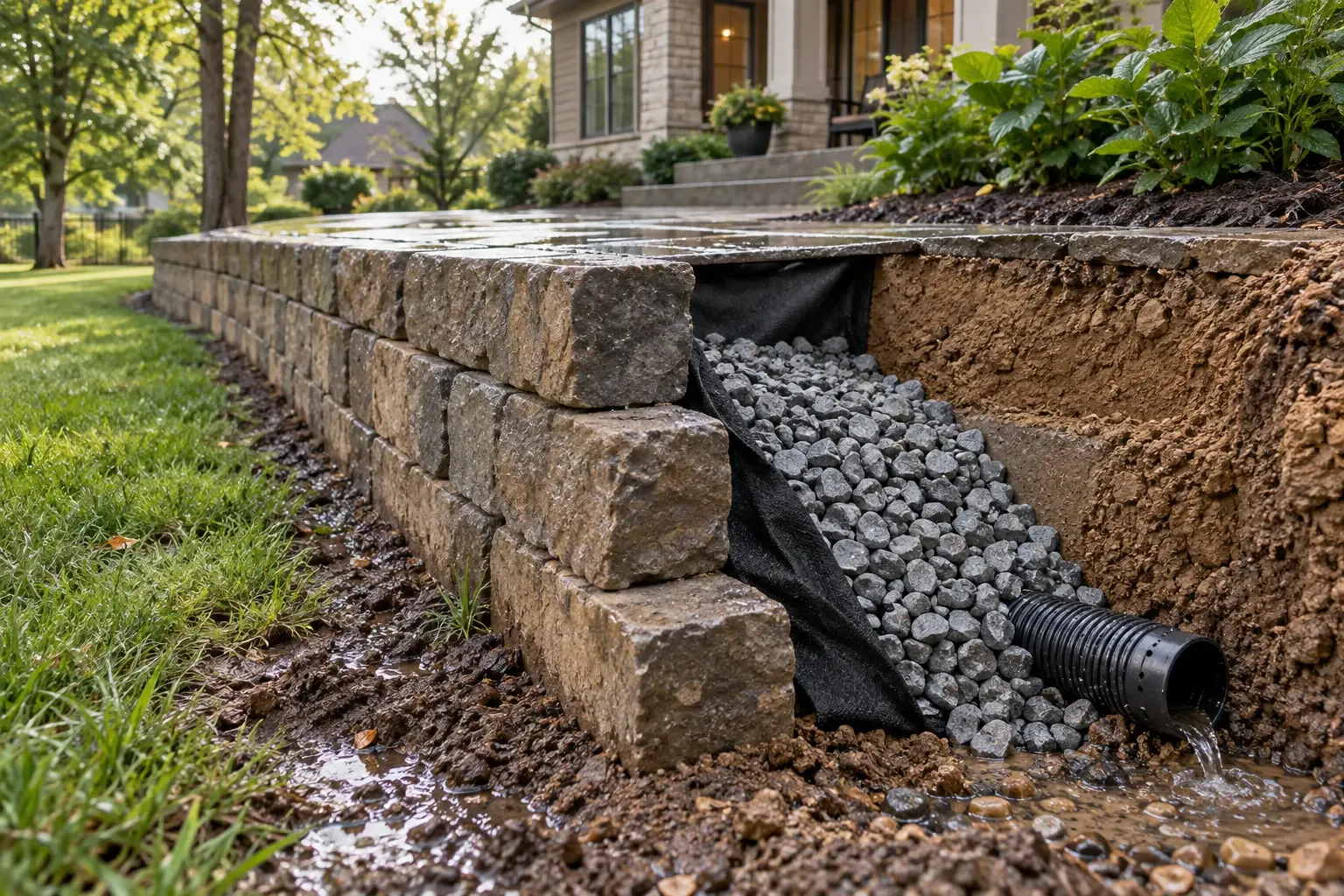
Allan Block describes how it starts. Fill behind a new wall settles, and a low spot forms. Every rain collects there and works down behind the block. On flat ground above the wall, that becomes what Allan Block calls a "swimming pool" of soft, saturated soil, and a wall not built for that weight can blow out.
Tulsa's soil makes the water problem worse. The City of Tulsa's hazard plan says clay swells when it takes on water and shrinks as it dries, and that many higher elevations, including large areas of central and east Tulsa, have moderate to high shrink-swell potential. It counts 22,920 parcels in the city on high or very high shrink-swell soil, and ties the damage to cycles of drought and heavy rain. May alone averages 5.73 inches of rain in Tulsa, by the National Weather Service's 1991 to 2020 normals.
Other causes the guide and city pages name:
- Sprinklers and broken lines above the wall. The best practices guide calls for check valves so a broken line or head can't flood the soil above a wall.
- Roots. The guide warns that tree root balls planted behind a reinforced wall can disrupt the geogrid layers that hold it together.
- Digging nearby. New York's building department warns that new construction near a wall can undermine it.
- Weeds in the face. Allan Block says roots growing between blocks can open gaps and shift the wall over time.
What you can check yourself
Allan Block suggests looking over a wall four times a year, and especially after the wet seasons. The best practices guide, written for taller engineered walls, also calls for an inspection after major storms.
- Sight down the wall from one end. Look for a lean toward you, a belly in the middle or a course that steps out of line.
- Walk the top. Fill any low spots where water can stand, and look for cracks or holes in the ground.
- Walk the bottom. Look for soil pushing out, water seeping through, or washed-out gravel.
- Check the weep holes and drain outlets. New York's building department lists clogged weep holes among its warning signs.
- Point the downspouts and sprinklers away from the top of the wall.
Allan Block says minor settling from a soft spot under the base won't hurt the wall's strength, and a short section can be unstacked, leveled and restacked. A wall that leans, bulges or keeps moving needs someone to look behind it.
Repair or rebuild?
It depends on why the wall moved. A few cracked blocks or a settled section can often be repaired. A wall that is moving because water has nowhere to go behind it usually has to come down, because the fix sits behind the block: drainage gravel, a pipe to daylight and compacted backfill.
National cost guides give a sense of scale. Fixr, updated January 2025, puts most retaining wall repairs at $250 to $1,250, averaging $750, with leaning walls at $250 to $1,500 and crack repairs at $150 to $400. Rebuilding damaged sections runs $70 to $125 per linear foot in the same guide. Those are national figures, not Tulsa quotes.
If the fix is a new or rebuilt wall, the City of Tulsa's January 2025 guidelines apply: a zoning clearance permit for a wall up to 4 feet, measured from the bottom of the footing, and a building permit with an engineer's sealed design above that. Before anyone digs, OKIE811 says the law requires contacting it at least three business days ahead to mark underground lines. It's free.
Common questions
Is a leaning retaining wall dangerous?
It can be. HUD's inspection standard treats a wall 24 inches or taller leaning away from the soil it holds as a safety deficiency, since the wall could collapse. Keep people and vehicles off the top and away from the base until someone has looked at it.
Is a cracked retaining wall block a problem?
Often not on its own. The concrete industry's best practices guide says some cracked blocks don't weaken a segmental wall. Gaps between blocks wider than half the gravel size, or cracks that keep growing, point to movement.
What causes a retaining wall to bulge?
Usually pressure from the soil behind it, and water makes that pressure worse. The concrete industry's best practices guide says water adds load to a wall, and Tulsa's hazard plan notes that local clay swells as it takes on water.
Can a failing retaining wall be repaired, or does it need replacing?
A settled section or a few cracked blocks can often be repaired. Fixr puts most repairs at $250 to $1,250. A wall that failed because water collects behind it usually needs rebuilding with drainage behind the block.
How often should I check my retaining wall?
Allan Block suggests four times a year, and especially after wet seasons. Check again after any major storm.
Worried about a wall?
We repair and build segmental block retaining walls across Jenks, Bixby, Glenpool, Sand Springs and Sapulpa, starting with the grade, the soil and where the water goes. See how we build retaining walls or send us photos of the wall from the bottom and the top.
Sources: NYC Department of Buildings, Retaining Walls · Indiana Department of Transportation, Check List for Retaining Structures (PDF) · U.S. Department of Housing and Urban Development, NSPIRE Standard: Retaining Wall, v2.1 (PDF, April 2021) · Allan Block, Tech Sheet #797: Caring for Your Retaining Walls (PDF) · Concrete Masonry & Hardscapes Association, Segmental Retaining Walls Best Practices Guide (PDF, hosted by Rochester Concrete Products) · Concrete Masonry & Hardscapes Association, SRW-TEC-008-12: Inspection Guide for Segmental Retaining Walls · City of Tulsa, 2019 Hazard Mitigation Plan (PDF): expansive soils · National Weather Service Tulsa, May climatology · Fixr, Retaining Wall Repair Cost (updated January 31, 2025) · City of Tulsa, Residential Building Guidelines (PDF, January 2025) · OKIE811, Homeowners