
Mulch: how deep, which kind, and when to refresh it
Spread wood chips or bark 2 to 4 inches deep, keep it 4 to 6 inches off trunks, and top up in spring only where the old layer has thinned.
· Tulsa, Jenks, Bixby, Glenpool, Sapulpa, Sand Springs
The short answer
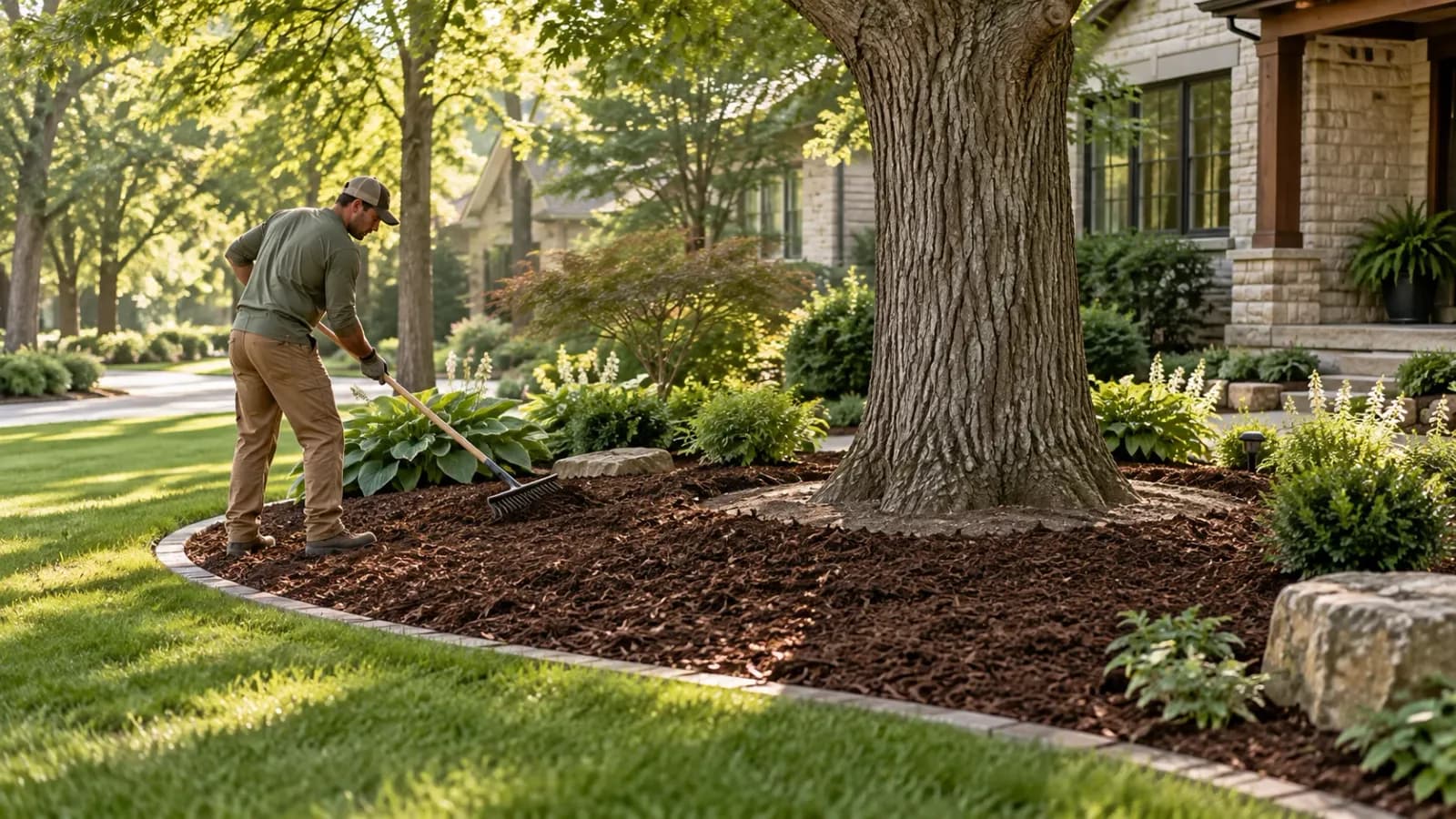
Keep landscape mulch 2 to 4 inches deep and pull it back 4 to 6 inches from tree trunks and shrub stems. Use the thinner end, 2 to 3 inches, for fine or composted material and on heavy soils; use 3 to 4 inches for coarse wood chips and shredded bark. For most beds that means one top-up a year, and OSU Extension's timing is spring, once the soil has warmed.
The most common mistake goes the other way. University of Illinois Extension lists overmulching and mulch piled against the trunk among the most common causes of tree decline.
How deep, by material
Depth depends on how fine the material is. Fine material packs down and seals the soil faster, so it goes on thinner.
| Material | Depth | Source |
|---|---|---|
| Wood chips, shredded bark (coarse) | 3 to 4 inches | Illinois, Iowa State |
| Compost and composted mulches | 2 to 3 inches | Illinois |
| Any mulch on heavy, poorly drained soil | 2 to 3 inches | Iowa State |
| Sawdust | 1 to 1.5 inches, partly decomposed | OSU HLA-6005 |
| Straw, hay (vegetable gardens) | 4 to 8 inches | OSU HLA-6005 |
Iowa State Extension explains why heavy soils get less: too deep a layer can waterlog them and cut off oxygen to the roots. Too thin a layer does nothing for weeds.
Around a tree, Illinois says to spread mulch out to the dripline or as far as you can, with a 3-foot radius ring as the maximum for most trees. A wide, flat ring beats a tall pile.
Keep it off the trunk
A cone of mulch piled up the trunk, often called a mulch volcano, holds moisture against the bark. Illinois says that softens the bark and opens the door to insects, disease and girdling roots. Iowa State adds fungal cankers, root rot and rodents to the list, and OSU Extension warns mounded mulch can cause trunk rot.
The sources give slightly different gaps. Illinois says at least 4 inches from the trunk; Iowa State and Colorado State say at least 6. Six inches covers both. If mulch is already piled against a trunk, Illinois says to pull it back several inches until the base of the trunk shows.
Which kind
Wood chips and shredded bark
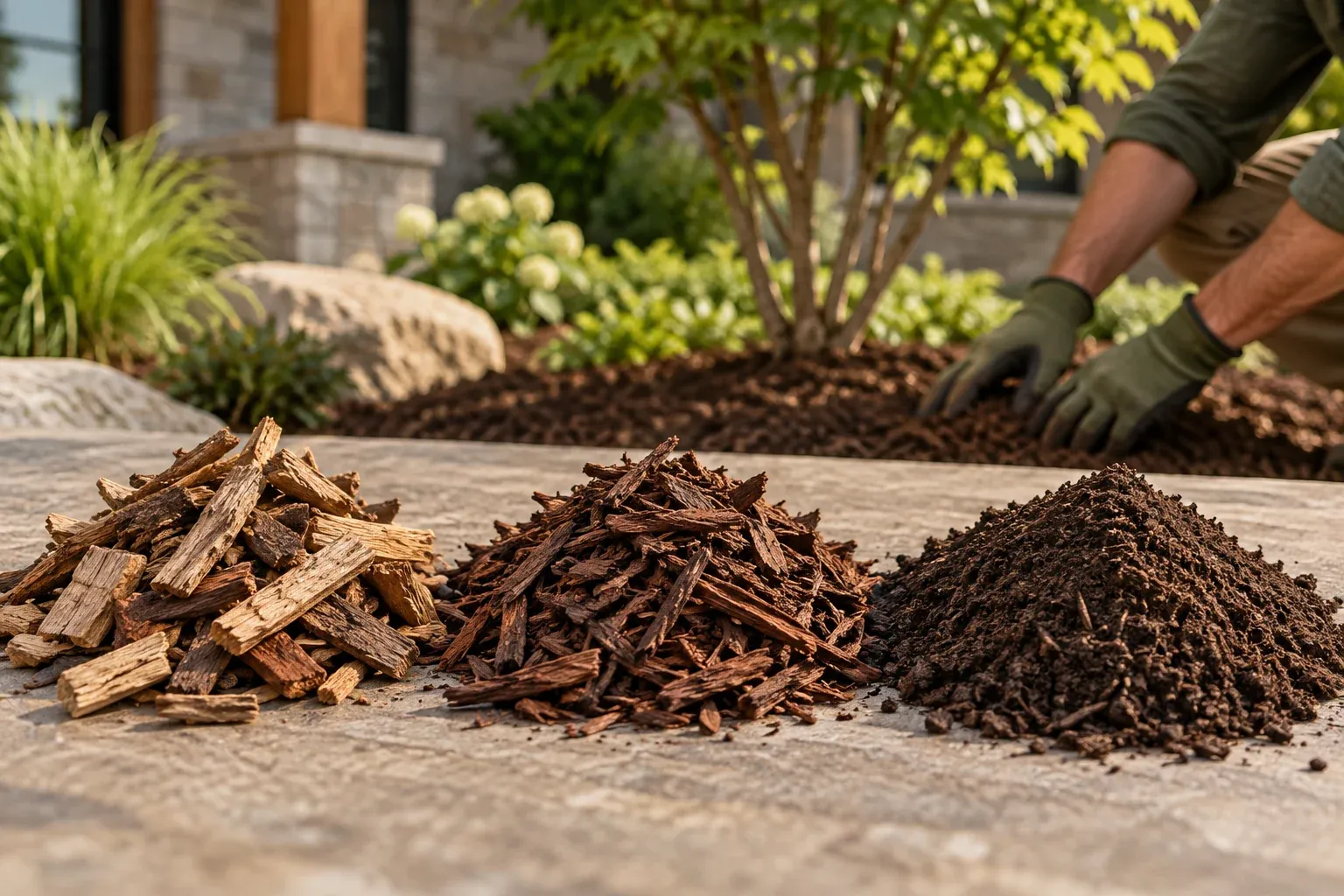
These are the standard choice for shrub and tree beds. OSU's mulch table calls wood chips and bark an excellent permanent mulch, and Colorado State says wood chips break down gradually.
A common worry is that wood mulch steals nitrogen. Colorado State Extension says wood chips and bark on the surface do not tie up soil nitrogen. The problem starts when wood is mixed into the soil, where microbes use nitrogen to break it down. Oregon State gives the same advice: leave chips on top and let worms work them in over time.
Compost, leaves and pine straw
Finer organic mulches feed the soil faster as they decompose. OSU Extension notes that Oklahoma soils often run low in organic matter, and organic mulch worked into the soil at the end of a season adds it back. The tradeoff is speed: Colorado State says grass clippings and leaves break down fast and need extra layers during the growing season. OSU says never to use fresh grass clippings as mulch; compost them first.
Skip anything from black walnut. OSU HLA-6005 says walnut sawdust, bark and leaves are very toxic to some plants.
Dyed mulch
Red and black mulches are usually made from recycled wood. UMass Extension says the dyes themselves, mostly iron oxide or carbon based, show no evidence of toxicity. The risk is the wood: some recycled wood from construction and demolition waste carries CCA, the arsenic-based preservative once used in pressure-treated lumber. Ask the supplier where the wood comes from before you buy in bulk.
Rock and gravel
Rock never needs topping up, but it adds nothing to the soil. Colorado State says stones work as mulch only up to about half an inch across, and gravel passes more heat into the soil below than wood chips do. That can help plants through a cold winter, but Colorado State notes it can also heat nearby buildings and utilities.
Colorado State and OSU both recommend against landscape fabric under mulch. OSU says it clogs with soil over time and cuts water and oxygen to the roots, which pulls roots up toward the surface. Colorado State notes weeds still sprout in the mulch on top.
When to refresh it
Spring is the main window. OSU Extension says to mulch soon after plants come up or go in, and to wait if the soil hasn't warmed yet or the spring is very wet, since roots can grow up into the mulch layer.
Top up only what's gone. Organic mulch breaks down and needs replacing, and UF/IFAS puts that at about once a year for most organic mulches. But Illinois says to wait until the old layer has decomposed. Check the depth first. If there's still enough, rake it to break up matted spots and freshen the look instead of adding more.
Winter mulch is a separate job. For tender perennials, OSU HLA-6005 says to apply winter mulch after plants go dormant, usually in very late December, using loose material like straw or pine needles. Our winter yard prep checklist covers the rest of the season.
How much to buy
UF/IFAS gives the math. Multiply the bed's length by its width to get square feet. For a 3-inch layer, multiply by 0.25, then divide by 27 to get cubic yards. One cubic yard covers about 108 square feet at 3 inches deep, a figure the University of Tennessee Extension gives too.
A 10-by-30-foot bed is 300 square feet. At 3 inches, that's 300 × 0.25 ÷ 27, or about 2.8 cubic yards.
Common questions
How deep should mulch be in flower beds?
Two to three inches for fine or composted mulch, three to four inches for coarse wood chips or bark. On heavy clay that drains slowly, stay at two to three inches so the soil doesn't stay waterlogged.
Should I remove old mulch before adding new?
Usually not. Check the depth. If the old layer still sits in the 2 to 4 inch range, rake it to break up matted spots instead of adding more. Add new mulch only where the old layer has broken down.
Does wood mulch take nitrogen from plants?
Not when it sits on the surface. Colorado State Extension says wood chips and bark on top of the soil do not tie up nitrogen. Mixing wood into the soil does, because microbes use nitrogen to break it down.
When is the best time to mulch in Oklahoma?
Spring, once the soil has warmed. OSU Extension says to wait in a cold or very wet spring. Winter mulch for tender perennials goes on after they're dormant, usually in late December.
How much area does a yard of mulch cover?
About 108 square feet at 3 inches deep. For any bed, multiply length by width, multiply by 0.25 for a 3-inch layer, and divide by 27 to get cubic yards.
Getting it done
Mulch refresh is part of our lawn care plans in Jenks, Bixby, Glenpool, Sand Springs and Sapulpa, along with bed care and seasonal cleanup. Bed area and material quantities go in your quote. Send us a few photos of your beds and we'll put the work and the price in writing.
Sources: University of Illinois Extension, Proper mulching techniques (PDF) · Iowa State University Extension, How deep should the mulch layer be around trees and shrubs? · OSU Extension, Mulching garden soils, HLA-6005 (PDF) · OSU Extension, Mulch a multi-purpose matter in the landscape · CSU Extension, Mulching, GardenNotes #245 · Oregon State University Extension, Wood chips for mulch? · UMass Extension, Colored bark mulch · UF/IFAS Extension Alachua County, Using mulch effectively (PDF) · University of Tennessee Extension, Using mulch in the landscape (PDF)